
IADS Exclusive Articles

IADS Exclusive - Reinvention at Galeries Lafayette
IADS Exclusive - Reinvention at Galeries Lafayette
125 years of history in commerce and retail, 290 stores, 14,000 employees, usually 60 million visitors per year and EUR 4.5 billion in yearly turnover (pre-pandemic): those are a few figures describing the Galeries Lafayette Group. But it is especially famous for its prestigious boulevard Haussmann flagship store. Usually relying on 200 nationalities accounting for 60% of its EUR 2 billion yearly turnover (2019 figures), the store occupies the coveted, yet challenging number one position of Paris’ department store scene.
Being number one implies being able to stay in step with customers’ expectations, attract Millennials and GenZ, as well as locals and tourists thanks to a great product offer, convenient services and memorable experience. And in 2021, after more than 200 days closed since the beginning of the pandemic, reinvention is also to be added to the list.
On 7 September, Alexandre Liot (Haussmann Store Director), Marianne Romestain (Chief Merchandising Officer) and Guillaume Gellusseau (Director of Communication and Marketing) unveiled the new “Le Grand Magasin de Tous” (translating to “a department store for all”) programme rooting in the very purpose of a department store: be a place for discovery, enjoyment and entertainment. We attended the press conference for you, and we are delighted to report back this exciting member news.
Reinvention, since 2018
In truth, reinvention started in the Haussmann store way before Covid with the “Programme Lumière” (translating to “Light Programme”) to run until its completion planned in 2024. Since 2018, the rooftop, kidswear, home, lingerie and a part of the beauty departments have been revamped to answer to a fast-evolving customer base. The historic dome has also been beautifully restored and transformed into an experience itself, thanks to a suspended gravity-defying glass walk platform (accessible from the third floor) allowing customers to get closer to it.
Digitalisation has also slowly developed: as stated during the press conference, e-commerce was only accounting for 2% of the turnover in 2019 and now reaches 25%. Such tremendous transformation basically happened in 4 months showing the company’s agility and ability to adapt. E-commerce is expected to stabilise at a 15% to 20% business share once life is back to normal. It has implied a true change in the way the store is considered: Galeries Lafayette’s management is now referring to the Haussmann store as a ‘navire phygital’ (translating to ‘phygital ship’) instead of the usual flagship store expression.
Reinvention at Galeries Lafayette is underpinned by 4 strategic objectives:
- Accelerating on local customers: despite a 60% share of international customers, Galeries Lafayette started refocusing on locals by redesigning its loyalty programme at the end of 2019.
- Remaining an unmissable Parisian attraction in a context of increased competition with the opening of La Samaritaine: on top of the expected fashion offer, the store wants to propose experiences through restaurants, cultural events and new partnerships that will be disclosed in 2022.
- Keeping its position with international shoppers: despite the absence of Asian tourists, performances with European, Middle-Eastern and American customers have been quite good considering the travel restrictions. Since the store reopened last May, the turnover achieved with these customers is “only” -20% compared to 2019.
- Benefitting from new growth engines appealing to younger generations: with the second-hand business.
These 4 objectives are very clearly reflected in the new Haussmann store propositions: a new highly attractive women’s shoe floor able to appeal to both locals and tourists, and a women’s ready-to-wear offer renewed with ‘Instabrands’ and circular fashion options, in step with Millennial’s and GenZ’s expectations.
New women’s shoe floor: the higher the heel, the closer to heaven
It’s literally true as the Haussmann women’s shoe floor moved from the basement to the fourth floor. Comparing to the previous location, the move includes new brands and extended footage, making it the biggest women’s shoe department in Europe with a 4,000 sqm surface. The large offer justifies a trip to the store and is, without a doubt, the most relevant in Paris.
Covering Luxury, Premium and Mid-range price segments (respectively accounting for 35%, 20% and 45% of the offer in 2020 (according to the information gathered during the last IADS Merchandising Meeting dedicated to Leather Goods & Shoes), the assortment now proposes 200 brands, 60 corners, 35 exclusive products and 10,000 SKUs. The shoe floor also brings innovation in the way brands are segmented and displayed. Two large lookalike multi-brand stores are available to the customers: the ‘Designer Galerie’ gathering luxury brands such as Alaïa, Balmain or Maison Margiela, and the ‘Creative Galerie’ offering “emerging” labels like Ganni, Rejina Pyo or Staud, both spaces being filled with natural light with an eye on Paris’ rooftops. A third multi-brand store has been designed to embrace the casualisation trend: the ‘Sneakers Galerie’ features a nice 20-metre luminous wall and offers all sorts of options from classic brands such as Nike and Adidas, to creative labels like Axel Arigato or Eytys..., and responsible ‘Go for Good’ labelled brands (Spring Court, Faguo, Good News, Viron...).
Circling around the base of the famous dome, the shoe department has been designed by Belgian architect Bernard Dubois. The design concept is mixing hardwood and concrete floors. Colours are evolving around earth tones, display furniture is made of concrete resin and medium wood. Impressive large resin rocks, where seats have been carved out, are giving visual rhythm to the shop floor.
The floor is completed by a Maison Michel shop-in-shop and a shoe repair/recycling station run by Veja. Customers can also buy Pierre Hermé macaroons or have a latte at EL&N, a coffee shop coming from London and naming itself “the most Instagrammable café in the world”. A concierge counter is also available as well as a Kure Bazaar mani-pedi station.
Premium and Mid-range women’s fashion: brands, brands, brands
Between 2020 and 2021, Galeries Lafayette embarked on 140 new brands, no less. As a result, a third of the brands have been renewed, bringing a much-needed offer-refresh able to appeal to younger local customers. Taking advantage of the store closures, the women’s fashion department has been revamped on the second and third floors, the ones dedicated to the Premium and Mid-range offer. In 2020, these price segments are respectively representing 30% and 20% of Galeries Lafayette’s womenswear business, the Luxury segment accounting for 50% (according to the information gathered during the last IADS Merchandising Meeting dedicated to Women’s Fashion).
Three new spaces are contributing to a clearer and more appealing brand segmentation: an Instabrands-DNVB (Digital Native Vertical Brands) space, the ‘Social Galerie’ and the ‘Creative Galerie’ (echoing its sister from the shoe floor) which will be renewing brands and offers on a regular basis. Brand corners have been revamped with new common signage, contributing to a clearer impression. The lingerie area, a new denim bar and a ‘fashion sport’ section complete the 2-storey offer.
The ‘Creative Galerie’ is a 225 sqm space nested on the second floor and gathering about 30 brands (including 15 new ones): the selection is dedicated to fashion addicts and is quite edgy. Customers can shop brands such as Stella Nova, House of Dagmar, Nanushka, Rejina Pyo, Anine Bing, The Frankie Shop… Additional new ready-to-wear brands are complementing this new space: Ganni, Laurence Bras, Proenza Schouler White Label, Valentine Gauthier, Dawei…, but also accessorie brands such as Staud for the leather goods, Annelise Michelson or Gossens for the jewellery.
On the third floor, new sections are displayed to appeal to Millennials and GenZ: the ‘Social Galerie’, and a large space dedicated to DNVBs and ‘Instabrands’ such as Songe Lab, Janne Mill or Pretty Wire. These brands are opening their first physical stores, showing once again how relevant a department store is to the development of such labels. The ‘Social Galerie’ is a unique concept where customers will find digital-native brands offering accessories, last-minute gifts and souvenirs. A famous DNVB will also launch during the next Paris Fashion Week: Skims by Kim Kardashian. Putting together these new sections surely benefited from Galeries Lafayette Champs-Elysées, the first to offer niche and Instagram brands.
(Re)store, a new venture in the responsible fashion market
Three years after launching their ‘Go For Good’ label which highlights products with a reduced impact on the environment, Galeries Lafayette is opening a large section dedicated to circular fashion on the third floor. ‘(Re)store’ is clearly designed for the younger generation and is associating vintage products through 7 different partners (Monogram, Relique, Petite Chineuse…) and eco-responsible labels, and ranges from Luxury to Mid-range price segments. Services are complementing the offer. A resale salon is available to customers: depending on the item, one of the partners will deal with the client’s pre-loved item. A collection point for donations to associations is also planned. An innovative hardware store featuring products in step with a more responsible way of life offering knitting kits, made in France accessories, organic washing products… occupies a fair share of the space. A new attractive digital-native concept, ‘Club Couleur’ (translating to ‘Colour Club’ is reviving second-hand objects (fashion, accessories and decoration) by re-colouring them.
Start spreading the news
Such revamp is supported by a 360° omnichannel ad campaign imagined by DDB agency, photographer Lei Wei Swee, and filmmaker Jason Yan Francis: it includes social networks with a film blasting an exclusive Marc Cerrone disco music, billboards and press ads, a set of emojis, store windows... Four values are at the heart of the campaign: joy, inclusivity, energy and a youthful spirit. It is full of rhythm and colours and is supposed to speak to all customers from queens (aka older customers), cowboys (appealing to the new masculinity), innocents (kids), beauty addicts, artists (for the home lovers), educated palates (Lafayette Gourmet), trendsetters and visionaries (echoing the company’s responsible offer). The campaign is all about the enjoyment to be found in ‘Le Grand Magasin de Tous’, reminding of Galeries Lafayette’s founder whose philosophy was to gather everything and everyone under the same roof.
***
As an introduction to the press conference, Alexandre Liot was saying that “under such challenging circumstances, it’s all about dying or acting and reacting”. Clearly, Galeries Lafayette picked the second option and has set an ambitious women’s fashion revamp as a new chapter of the ‘Programme Lumière’. This new chapter is all about the Haussmann store, and after recently announcing that 11 provincial stores will become franchises, this is confirming again the company’s refocus on flagship locations.
Competition is gaining traction and the ‘phygital ship’ now has to compete with the brand new Printemps commitment to sustainability and has to be strategically poised for the return of tourists. The Asian tourism consumption in Paris is a large business but the cake is not extensible, so it’s key for the department store to be ready to win the fight against DFS-La Samaritaine. The ‘Programme Lumière’ is not fully achieved yet so we’ll see what the next moves will be. In the meantime, optimism for the future shows thanks to the addition of a new flight of escalators. Installed to better handle the customer flow and unclog circulation on the ground floor, Galeries Lafayette Haussmann is ready for hordes of customers when life is finally back to normal.
Credits: IADS (Christine Montard)

IADS Exclusive - Transformation in retail: Innovative Thinking Interview with Jakob Sand, BIG
IADS Exclusive - Transformation in retail: Innovative Thinking Interview with Jakob Sand, BIG
2020 has been an unprecedented year for all of us, and by the magnitude of changes it brought, it literally changed the world. By grounding the whole planet at home, it brought some space and time to reflect, especially when it came to examining changes in retail:
- Digitalisation and new purchasing habits,
- Work from home and the question of commuting,
- Notion of essential vs. non-essential goods.
*All our members, in addition to the obvious economical impact of the various closures they had to go through, witnessed significant changes in terms of how they were approaching their customers and their markets, leading to key changes both in their operating model and in their organisation.
We are launching a series of interviews with key innovative thinkers to understand the magnitude of the changes, and their views on how to deal with them. All organisations have proved their resilience and ability to cope with the emergency of the situation, however, it is a very human thing to tend to come back to habits whenever possible. What happened? How can we make the most of what we learnt and how can we make sure our organisations and thinking processes are durably impacted?*
Introduction: Jakob Sand from the BIG Group
For this session, we welcomed Jakob Sand, partner of the Bjarke Ingels Group (BIG).
BIG is a group of architects based in Copenhagen, New York, London, Barcelona and Shenzhen, founded in 2005 by Danish architect Bjarke Ingels. BIG got famous with innovative projects such as:
- Living units: “Mountain Dwelling” in Copenhagen (10,000 sqm of housing and 20,000 sqm of parking space with a mountain theme), or the “8 Houses” project in Denmark,
- Public utility: Amager Resource Centre in Copenhagen, a waste to energy plant doubling with a ski slope,
- Corporate projects: The Google HQ in the US, Lego House in Copenhagen,
- Mixed-use buildings: The pyramid-shaped mixed-used building of Via 57 West in NY,
- Other projects: National Art Gallery in Nuuk, the Big U defence in lower Manhattan and many more (such as the Riverside project in NY),
- In retail, the group is known for having made the Galeries Lafayette Champs Elysées store.
Today, the group represents 600+ people with a holistic approach including all functions and disciplines.
Jakob Sand joined in 2011 as a partner, with previous experiences in Denmark and France with Dominique Perrault. He overviews projects at the global level.
Part 1: How to cope with innovation?
*IADS – Jakob, Bjarke Ingels has been named innovator of the year for architecture in 2011, and among the top 100 most influential people in 2016. Charismatic, known for his sense of humour, can you recall your first encounter with him and your feelings / thoughts at the time?*
Jakob Sand: We met in Paris as BIG had just won the Sorbonne University project, which was the first French project the group had to handle. I met with Bjarke very casually and we walked through the city as old friends, towards the university. It was not before we entered the building that we started to discuss this very project.
Bjarke is very easy to get along with, and what struck me was his curiosity: he was curious about my history and not worried at all about filling me in with the project and deadlines! Rem Koolhas, his former employer, once described him as “the only architect without angst”.
I think that his curiosity, fearlessness and positivity on how to tackle the problems brings us a lot of ideas and helps the group push the boundaries. This is probably why the BIG group has no specific signature style: although our buildings are certainly recognizable, they are all significantly different because when we start a project, we just do not know where we will land. He always challenges us to the maximum.
Combined with his talent, his curiosity helps us solve seemingly inextricable situations, by providing both a new approach and an almost scientific frame. Even in the most challenging moments, we are always confident that we will get somewhere. This specific methodology is probably one of our greatest points of differentiation on the market today.
Funnily enough, ten years later, this Sorbonne project in Paris is finally being built!
IADS – BIG is widely known for its innovative thinking process and ideas. How does that translate into the corporate culture? Any tips on best practices to onboard newcomers in innovative companies? Did you have to “unlearn” things?
JS: I did not have to “unlearn” as many of our projects are very classic, we just define our own approach. My previous experience was ideal when I joined, as Dominique Perrault is quite bold in his approach. Rather than unlearning, it is more about knowing history. As a good friend says: “the future starts in the past”. Even if our projects sound futuristics, they start somewhere, with references, studies and understanding of the context. It is just about making the right due diligences.
In terms of general organisation and our approach to innovation, even though Bjarke has his vision and methodology, we need to make it trickle down, not only between the 16 partners but at all levels in the 600+ staff. To achieve that, we empower everyone, in full transparency and sharing. There is no secret room where senior partners develop projects: from interns to the top level, we share information and updates on a weekly basis (let’s say it is a huge PDF sent on a weekly basis). This helps us save a significant amount of time.
Also, as many of the partners have started as interns in the company (I am an exception), the group culture is apparent at all levels. Everyone is encouraged to generate ideas, and any idea is welcome, wherever it comes from. There is no “we normally do like this” approach, but on the contrary, we are on a “what if” posture. This strongly contributes to talent retention, and this is how, for instance, we came to combine a bridge and an art gallery together in Norway in one of our projects (The Twist).
IADS- From a very practical point of view, how do you manage creativity within an international and multicultural organisation?
JS: We give responsibilities according to talent, not experience or time spent in the company. This empowers and motivates people. Some of our young talents can even feel overwhelmed with the level of responsibility they are given. But this is our way to foster talent and make them grow. Everybody is given the possibility to pitch their ideas, from interns to senior partners.
Regarding the weekly exchange, the PDF file is organically shared within the organisation. A comment from Bjarke goes to everybody, and vice versa. Of course, we are developing an app to make it more practical and optimized.
IADS- Has BIG Group gone through any kind of transformation due to the Covid-19 pandemic and if so, what and how where they dealt with?
JS: We were given 36 hours to “digitalize” the organisation, and make sure all employees could work from home. As architects, we already had the infrastructure needed to do so, as we deal with heavy files between offices across the world. For us, the change was not so much technical, but rather human: we were finally able to use tech to separate really important meetings, where you have to be physically present, to the other ones, where video conferences do the job.
While we knew technologies work and contribute to save time, we learnt the value of physical presence, which allowed us to review how we work, and when/where. This leads to a new balance, which is positive for all.
Part 2: BIG Group view on innovation in retail
IADS- Looking back: what did BIG learn with the Galeries Lafayette Champs Elysée store?
JS: We owe a lot to Galeries Lafayette for trusting us. They wanted us to bring in a fresh eye, and this is the reason why our partnership was so fruitful, as it mixed their experience and knowledge and our open approach, not taking anything for granted but on the contrary, raising “why not” questions.
I like to think of our approach as a “pragmatic utopia”: pragmatic because of course, the bottom line is to be economically sustainable and sell products, but also utopia because we believe cities can be improved. This is why we wanted to make a store which is also a destination, where you can go and stroll, in a seamless way with the urban environment. We wanted to create a physical space where you feel good and comfortable. For instance, the sneakers section is bigger than what you normally find, with a stunning architectural element creating the attraction. It is the same thing with the pinwheels moving around for watches or the giant moving belt for bags. We also created attractive glass displays on the second floor, which was a notoriously difficult floor for the previous owner.
Also, remember when I was mentioning the history? We discovered that this building used to be a bank, where customers could access a very luxurious vault in marble and precious stones. The fun part is that everything which was not visible by customers at the ground floor level was only covered with plaster, because why would you waste money on staff? We echoed this historical element by mixing a very luxurious marble and brass atrium and staircase with more contemporary white walls and a steel part, where you can find the perfumery today. This is a strong element of differentiation for the store.
We also decided to reveal the cupola, which has been masked by the former owner and created a meeting spot beneath it, like a plaza. This is what retail is about: being a natural spot where you meet your friends during a rainy day (but not only!).
IADS- What is the department store’s role for you in 2021? Should we consider it to be part of the “1% buildings” once mentioned by Bjarke as public buildings, such as churches, city halls and other public amenities? Or does it belong to something else?
JS: Put a store next to a public square. If people can sit in the public square, they will end up coming to the store. In other words, a department store needs to be a place to recharge, mingle, meet and spend time.
In the past, this was a corollary of the stores’ structures themselves: atriums were not here to be beautiful or a place to meet, but a very pragmatic way to have light come into the store and make products visible. People then appropriated these atriums as meeting places. With time, department stores wanted to maximize productivity by showing as many products as possible, closing spaces and creating floors. Thankfully we are at the end of this cycle and now visitors want space, place and a reason to come again.
I highly believe that the future of department stores is to be semi-public spaces, all the more that they are already enjoying key positions in cities. A department store is a natural part of the “1% buildings” where all senses are solicited to buy products, but not only. This is a clear competitive advantage over the internet!
It does not mean that there might not be fewer department stores, though! We are currently working on a project in Düsseldorf where one store is closed and the second one across the road kept, as they were both built in the pre-internet era. A funny point on this project: we decided to transform the road in front of the remaining store into a pedestrian area. Everybody was stressed, as “cars give energy in front of the store”. This is not the right approach: if you have passers-by, benches, trees… you will have probably much more qualified traffic for your store than cars passing by… usually cars do not come into stores!
IADS – What are your frustrations, if any, for retail? Can architecture solve all issues?
JS: No frustration on our end. Everything depends on the readiness of the retailer we are working with. Galeries Lafayette was forward-thinking, but for other projects we feel sometimes we are asked to design for the past, to stick to well-known recipes… Retailers know their part, and we are not here to teach them new tricks, but experimentation and new ideas are key to reinvent retail.
Architectural alchemy is about mixing ingredients: retail with leisure, entertainment.. a new function. For instance, for Google in California, we decided to gather almost 3,000 people on the same floor under the same roof, as we believe this reflects the new ways of working.
The toughest thing for architecture in retail is not the structure, but the mindset.
IADS - Retail is also about people – customers, but also and equally importantly sales teams. How do you take them into account in your projects?
JS: We all want meaning and purpose. This goes for any employee of any industry. The quality of offices can increase loyalty and even motivate employees to stay extra hours, thanks to a rooftop, a gym…
The topic of sustainability is particularly critical for the younger generation. We need to make them believe in and be proud of, the values promoted by the company. Our role, as architects, is to express that when they work in this particular building, they are part of a bigger plan (making a better city, a better planet…).
IADS – Is the store of the future a store at all?
JS: I am sure that a wholly virtual world is exciting. For me, the store of the future is physical! My 9-year-old who intensely uses her iPad and iPhone really enjoys going to stores to test, try and touch. We are human beings after all.
It is probable that we will see new experimentations with stores, in open air, on highways… why not? it will be rethought in many ways, but I am confident department stores will remain relevant in the future.
They just need to keep on inventing and experimenting. For instance, we are working on an Opera house in Germany where we chose to show backstage mechanisms to spectators. A similar approach could be applied to department stores, where you could see the system fulfilling your orders in real-time, for instance.
Technologies are there. In Danish, design means “giving a form to something which does not have a form yet” or giving a form to the future. All IADS members have the possibility to define by themselves the form of their future, and that is pretty exciting!
Credits: IADS (Selvane Mohandas)
IADS Exclusive - Retail Review #5: spectacular stores
IADS Exclusive - Retail Review #5: spectacular stores
Keeping markets under close watch, IADS collected spectacular store concepts from retailers around the world. This collection of stores offers jaw-dropping displays that will draw customers from near and far.
Check out how retailers are using surprise effects and creativity to fundamentally challenge traditional retail concepts to create desirable experiences and spectacles.
Apple, Los Angeles
Apple Tower Theatre is a new store designed inside of an abandoned 1920s movie theatre in downtown LA. Inside, there is a grand entry hall designed in the style of Charles Garnier's Paris Opera House, complete with bronze handrails and marble columns. Apple plans to use the space as an auditorium for daily skills workshops and presentations from local artists.
Louis Vuitton, New York City
The French fashion house opened the doors to a temporary men’s pop-up in the SoHo neighbourhood. The space, featuring a spectacular color palette, hosts a product selection from the artistic director, Virgil Abloh. The installation is part of a series of men’s global fashion events named ‘Louis Vuitton: Walk in the Park’.
MORE ON louis vuitton new york city
Gentle Monster, Seoul
The new Gentle Monster store in Seoul, Korea does not conform to the typical template of eyewear stores. At the entrance, an army of androids welcomes customers and directs them to screens with hyper-real images. The space also features a giant metallic spider that is independently animated.
ENG, Shanghai
ENG is setting up a second concept store in Shanghai. Featuring a futuristic spaceship interior and buzzy atmosphere, the store has proven to be a hit with Chinese Gen Z customers. With a palette of silver, white, and electric blue, the shop floor displays holographic projections and vending machines where products can be purchased.
Fendi, New York City
Fendi has opened a flagship in NYC at 57th and Madison Ave. The highlight of the store is a jaw-dropping sphere suspended from the centre of the second floor. The location also offers a VIP room and a lounge that can be closed off by ivory curtains. Every aspect of the store is dripping with luxurious attention to detail.
Luxemporium, China
Luxemporium is expanding to second-tier cities with its store concept in Changsha. The store is themed ‘Parallel World’ and features various sections boasting futuristic aesthetics with metals playing a dominant role in the design. Lights and shadows are used throughout the store to give different effects, such as a sunset.
IADS Exclusive - Capturing the wallet share of a Gen Z shopper
IADS Exclusive - Capturing the wallet share of a Gen Z shopper
What: Generation Z shoppers are not easy to win over and have a long list of demands for retailers and brands.
Why it is important: Gen Zers are the influencers that can impact the buying decisions of the generations before them. Retailers need to constantly understand and adapt to the needs of younger generations to stay relevant.
Introduction: Generation Z shoppers are a completely new beast for the retail industry to market and capture. They are digital natives that have little patience for errors and value their personal brand above all else. Although they can be tough to appeal to, they are easily won over through loyalty programs and perks. Taking the right steps to impress these young shoppers will be vital for brands and retailers to stay relevant.
Meet Generation Z
Move over Millennials, retailers and brands are setting their sights towards a new buyer persona: Gen Z shoppers. People labeled as Gen Z were born from 1996 and after. While these shoppers are still young, they are known as the “influencers” which means they have an impact on what Millennials and Gen Xers buy. This does not mean that Millennials are irrelevant, but rather Gen Z can be leveraged as trend setters. Before the pandemic, Forbes reported that Generation Z had a purchasing power of USD 143 billion.
IBM and NRF conducted a survey of 15,600 Gen Zers from 16 countries examining their shopping habits and values. Some trends that Gen Zers expect from retailers are accurate inventory information, value for their money, a wide assortment of choices, innovation and technology that enhance encounters, and individualized shopping experiences.
As seen in Figure 1 below, choice, availability, convenience and value have major impacts on where Gen Zers shop. While GenZ does not practice brand loyalty just yet, research suggests that as they get older they will start to become more loyal, so brands need to try and make a lasting impression while they are in this discovery stage.
Surprisingly, Gen Zers prefer to shop in the physical store compared to online. This does not mean that they don’t also use digital shopping channels, but they expect unique and personalized experiences online and in stores through the perfect marriage of digital and physical channels. TX Youth Energy Centre in Shanghai creates the ultimate experience by combining fashion, street culture, and clubbing under a single roof to “become a cultural landmark for youth.”
Reaching Gen Z on social platforms
Connecting with Gen Z on social media allows brands to interact directly with these young consumers while also capturing key data points about their preferences. These data points can then be leveraged to suggest personalized and unique product suggestions to Gen Z shoppers, which they also see as an important service that brands should offer.
According to the GlobalWebIndex, people from the ages of 16 to 24 spend an average of seven hours per day online with three hours dedicated exclusively to social media channels. Classic social media platforms like Twitter, Snapchat, and Facebook have seen reduced traffic as more popular platforms like TikTok or online gaming platforms like Fortnite grow in popularity. This is another reason brands will need to constantly evolve to stay current with what is important and trending with these younger shoppers.
Gen Z has completely reinvented social media marketing and brands need to adapt and reconsider the platforms that are being used to reach younger audiences. Falabella has launched Falabella Play, a new multiplatform channel with interviews, music, and live broadcasts. The channel is transmitted on YouTube, TikTok, Instagram, Facebook, and Twitch to be able to reach their younger community of shoppers. Falabella Play has featured interviews with influencers and music artists, unboxings of products, and offers fashion trend videos.
Social media has become a place where e-commerce, entertainment, and social are fusing into one thanks to Gen Zers. Poshmark recently teamed up with Snapchat to offer Poshmark Mini, a social shopping experience in the app where shoppers can browse curated products without leaving the app, in hopes to introduce the resale platform to the Gen Z audience. This is a great example of a retailer meeting Gen Z shoppers in the formats they are using on a daily basis.
A Gen Z approved strategy
Gen Zers could be the secret to keeping physical stores relevant in this growing digital and omnichannel age. According to a survey conducted by A.T. Kearney, Gen Z considers shopping in stores as “retail therapy.” But in order to give this generation with high expectations and short attention spans what they expect, department stores need to consider communication methods, service offerings, and rewards carefully.
Communication needs to be authentic, concise, and include up-to-date lingo that Gen Zers respond well to. Social media and digital platforms should be a key area to target this consumer group to meet them on the channels that they actively use daily, with options to shop directly through these channels. Being transparent as possible around sustainability and other initiatives will also help Gen Zers feel more comfortable supporting a brand. For example, H&M has completely revamped their inclusion and diversity statements and promises “ to share [their] progress and achievements, as well as the challenges ahead.”
Service offerings like free shipping go a long way with Gen Zers as they search for value. Retailers need to harness the power of data collected through various channels to be able to propose unique and personalized products to Gen Z shoppers. Any technology that is adopted needs to be intentional and must enhance the shopping experience, otherwise Gen Zers will have no patience for it. Many retailers like Macy’s, Gap, and Neiman Marcus are offering flexibility through Buy Now, Pay Later payment services which attract younger customers. While technology is a place to pique Gen Z’s interests, physical stores should be prioritized as a place where they can enjoy picture worthy experiences.
Rewards are very important to Gen Z shoppers. As they value individuality, loyalty programs that offer curated freebies, make suggestions based on past purchases and searches, and remember their birthdays are sure to keep these shoppers coming back for more. H&M’s Membership Program offers customers points for each dollar spent, a welcome gift for signing up, exclusive discounts, free online returns, insider shopping events, and birthday offers. This loyalty program is a perfect blend of transactional benefits (coupons) and community-driven experiences.
Tactics to capture and retain Gen Z buyers
Generation Z grew up in an age of rapid improvement. They are digital natives that have a growing knowledge about data and how algorithms work on targeted campaigns, making them an even harder target to catch. Retailers and brands must take the right approach when coming after these shoppers to ensure that messaging is clear and authentic while also creating a personalized and unique experience across all channels. Understanding this generation’s influence on the consumer market and implementing a marketing strategy with them in mind is vital to survival in this digital and omnichannel age.
As Generation Z continues shuffling through trends, brands and retailers should keep a few things in mind. It is important to stay in touch with the younger generation and understand how to be able to reach them whether that be pertaining to channels they use or issues they care about. Agility and understanding is key to ensure marketing efforts are not lost. But just as Gen Zers value authenticity, it is important for brands to remain true to their missions and values and not sacrifice these things for the sake of relevance. As Generation Z starts to enter the workforce, their spending power will only increase with time, but understanding how your brand can uniquely capture some of their wallet share is important before investing in new tactics and channels.
Credits: IADS (Mary Jane Shea)
IADS Exclusive - Four startups retailers should consider from Vivatech 2021
IADS Exclusive - Four startups retailers should consider from Vivatech 2021
*What: Our visit and review of one of the most important Tech fairs in Europe
Why it is important: 4 interesting start-ups that we spotted for our members, with some potential for immediate retail applications.*
*Viva Technology (aka Vivatech) is a French fair dedicated to new technology, launched in 2016, and seen as the French response to the tech hype from California and the CES in Las Vegas. With the permanent support of the French President, Emmanuel Macron, who promotes the “start-up nation”, this tech fair became in 4 editions a rendezvous of choice, where all tech moguls from the world gave speeches (Mark Zuckerberg, Jack Ma, Satya Nadella from Microsoft), but also world leaders such as Justin Trudeau or John Kerry, and world figures (Usain Bolt, Bernard Arnault).
The 2021 edition was, due to the Covid-19 context, unique as it was one of the first mass-scale events to be held in Europe, organized in a hybrid way, with both a physical fair with live events, echoed by an online platform to maximize visibility. In terms of numbers, this meant 26,000 physical visitors and 114,000 users on the platform (to give a sense of comparison, the first edition welcomed in 2016 45,000 visitors, and the last pre-pandemic one in 2019 attracted 124,000 people).
We decided to attend this edition as we believe the IADS should help its members detect innovative approaches and solutions wherever they are, in complement to their own efforts. Also, it was a way for us to catch a glimpse of where “retail tech” stands.*
A quick overview of the key messages from top speakers
To say the least, this edition of the fair was politically charged.
Emmanuel Macron used Vivatech as a political platform to highlight the progress of the tech industry in France, both in terms of number of companies, jobs created or funding. He was echoed in that stance by Mirakl (a French company specialized in marketplace technology, working with a few IADS members and Hudson’s Bay and which we reported here), which discussed financing and going public.
Macron also pleaded for European cooperation in terms of start-up support, through the Scale-up Europe initiative, and for a closer control of what GAFA does. Tim Cook from Apple replied that the European proposed big tech mandate could affect the security of the Apple products system.
However, some other leaders decided to focus on tech itself, by giving some perspectives on the evolution of the industry.
Mark Zuckerberg from Facebook chose to promote his convictions about the appearance of a “meta-universe” where, through VR and 3D technologies, it will become possible to virtually produce, sell and buy items (i.e. instead of selling a TV, it will be possible to produce and broadcast the content directly to the audience, making the TV an obsolete product). Klarna (a buy-now-pay-later solution that we reported in our Exclusive article as well as here and here) ranted against banks, which are, according to the company, overcharging customers while its solution perfectly suits its 18M customers and 250,000 retail partners needs. Finally, Google made a spectacular announcement by confirming that it had inked a deal with LVMH to manage the group’s cloud capability (i.e. use its AI capability to help LVMH on topics such as CRM and customers’ knowledge, logistics and supply chain processes).
Interestingly, however, a macro view of the fair and the start-ups presenting their solution tended to show that retail tech was rather underrepresented, compared to other sectors of innovation such as transportation (autonomous vehicles, flying cars, shared fleets), health (improved capabilities of the iphone on that topic, among others), HR and video conferencing (AI to manage employees, systems to meet virtually), or finance. Even the LVMH booth was somehow lacking retail-dedicated start-ups: out of the 12 presented, we spotted only one company that could be interesting for our members, the other ones being more adapted to brands than retailers (tactile packaging, in store display proposals (see the one we have spotted below), live-shopping solutions for brands, data analysis dedicated to grey market and second hand, or new materials).
Our top 4 selection for department stores
Here are the companies we spotted for our members during the fair:
1- A versatile tool for central HQ functions and marketing campaigns: Pitchy
- A seemingly simple tool, however with potential applications that go beyond the use cases displayed on stage.
- Pitchy is an AI-powered online video editor, that allows the making of high-quality videos quickly, simply and without any particular skills. They can be used online, on websites, but also on social media or in 1 to 1 communication. In terms of practicality, think “PowerPoint applied to video conception”. See how it works by clicking here.
- Why do we think this is important? A simple and versatile tool, that can be used at the HQ level on many topics (training, motivational or informational messages) but also on the sales floor when it comes to presenting a new product efficiently to inform customers, just with a phone, or by marketing departments to tease their next campaigns.
Contact: Jimmy Moe, International Sales Manager, jmoe@pitchy.io
2- A marketplace system, for real stores and offline promotions: Achille
- A reverse approach to marketplaces in order to promote real stores to local customers and let them have access to the best deals, offline.
- Achille is a device-driven solution that applies the principle of marketplace (in terms of choice, offer and access to products) to real stores. The advantages for retailers are that Achille works exactly in the same way as a virtual marketplace, however is a great complement in terms of local business solution at a limited cost of operation. You can watch their demo video by clicking here.
- Why do we think this is important? A simple tool that comes as an extra software layer, thus not requiring heavy IT integration, which also provides a solution for our members who have a large regional network and want to make sure they cover all their types of customers, including the less connected ones.
To be noted: The IADS already showed to its members a similar solution, UK-based, during the Store Operations meeting in 2017: Nearst, founded by Nick Brackenbury
Contact: Fabrice Moncault, founder, fabrice@achille.shop
3- A circular packaging system: Hipli
- An interesting initiative, supported by LVMH, which provides to brands and retailers the possibility to guarantee a 100% sustainable delivery process thanks to circular packaging,
- Hipli has developed reusable packaging (envelopes, covers) that is shipped back free of charge by the customer upon receipt of the product. Hipli washes the packaging, prepares it again and reinjects it in the process. Packaging elements can be branded, and the solution is already 100% working in France, currently being expanded in Europe. The system works as a “Packaging as a service”
- Why do we think this is important? Hipli provides an easy to implement and non-industrially committing solution to members to move forward in their sustainability initiatives. For now, they have only inked deals with brands, but there is no reason why retailers should not be interested either. It is also a very visible step, that can provide significant PR coverage (contrary to other initiatives that, even though they are needed and useful, might be less visible and interesting for the general public).
Contact: Lysianne Coquin, cofounder, lysianne.coquin@hipli.Fr
<https://hipli.fr/en/>
4- A spectacular solution for windows, instore displays, but also live streaming: Fosfor
- The WOW effect in windows and on the sales floor, with a wide variety of animations in 3D that either represent the products on display or complement them with additional information. In addition to this, a solution for live streaming IADS members that could contribute to animate stores from the network while having the live session in the flagship.
- A series of state-of-the art screens and display technologies allowing jaw-dropping interactions with products (click here to see the video of their Totem Holix solution, applied to Kenzo). But more importantly, a camera and screening system allowing streaming in real time a 3-D, life sized picture of the speaker, in a clear and natural manner (click here to see the video of they Crystalman solution) . With the appropriate system, the speaker, wherever he/she is based, can interact with the audience watching the screen.
- Why do we think this is important? Live streaming sessions are now crucial for our members’ businesses, but can be expensive, all the more so if they involve a celebrity or an influencer. In addition, they tend to address only an online audience. We see this technological solution as a way to maximize the investment by being able to show the streaming in other stores, therefore creating occasions for drive-to-store events addressing the local clientele.
Contact: Cédric Besacier, cofounder, cedric@agence-fosfor.fr
Going further: IADS launches the “innovation channel” exclusively for its members
We believe that it is key that your Association gets more involved with the notion of innovation and transformation, be it digital or in other fields of application. This is the reason why, in the coming weeks, we will be launching new initiatives:
- Opportunities to discover start-ups that we think can be interesting for your innovation departments (with the guarantee of the IADS integrity as we do not have financial involvement in these ventures),
- More exposure on the subject of innovation through new content, developed in partnership with players from the tech industry,
- Interviews with innovative thinkers to discuss organisation of transformation and more.
Of course, we also welcome your suggestions! How would you like to be exposed to innovation? How could you contribute to this IADS innovation channel initiative? Do not hesitate to share with us your ideas!
Credits: IADS (Selvane Mohandas)
IADS Exclusive - La Samaritaine: what to expect after so many expectations?
IADS Exclusive - La Samaritaine: what to expect after so many expectations?
It's here!
Suspense was on almost until the D-day. The long-awaited reopening of iconic Parisian department store, La Samaritaine, is finally here after sixteen years out of business and a total investment estimated between EUR 750 million and EUR 1 billion.
Closed in 2005 for safety reasons, the initial renovation plan was aiming for a reopening in 2010. Renovation plans were only unveiled in 2012, with, at the time, a target opening date set for 2016. After some blockages from local authorities (before and during the course of the renovation), works didn’t begin until the end of 2014 and, later on, the opening was announced for April 2020. But due to the Covid pandemic, the opening was postponed to June 2021, although the precise date changed several times while getting closer to the date. After many changes and an official pre-opening event with French President Emmanuel Macron, La Samaritaine Paris Pont-Neuf – finally – opens its doors on 23 June. Luxury takes time as Bernard Arnault always says.
A little bit of history
La Samaritaine was founded in 1870 by Etienne Cognacq and his wife Marie-Louise Jaÿ. Both came from modest families, he was a hawker and she was a sales person at Le Bon Marché. Believing in innovative selling methods (fixed prices, clear price information, possibility to try on garments, easy in-store circulation …), the couple is a remarkable example of the social climbing that was linked to the rise of department stores at the end of the 19th century. Growing through the years, they ended up with a four-building store completed in 1932.
Having acquired Le Bon Marché in 1984, LVMH bought La Samaritaine in 2000 with the ambition to transform them in modern and trendy department stores, on both sides of the Seine River. However, the approach for La Samaritaine significantly differed from le Bon Marché (which is a LVMH entity), as it would be managed by DFS, the Hong Kong-based tax-free shopping division of LVMH.
(Chinese) tourists vs. locals
A first Duty Free Shoppers store opened in Hong Kong airport in 1960. In 1972, the company launched its first DFS Gallerias in Honolulu and Hong Kong. In 2013, DFS announced their intention to expand outside of Asia, by looking for a few European locations (France, Italy, Switzerland). The strategy was to rely on DFS’ brand awareness among Mainland Chinese shoppers and company’s understanding of Asian consumers to capture their spending when travelling to Europe. For DFS, at the time, “Chinese customers will continue to account for more than half of our revenue in several years to come”. In 2016 they opened their first European duty-free business in Venice, combining luxury and curated local products. While it still remains unclear if it is successful or not, DFS claims it has been attracting 3 million visitors in the first year. La Samaritaine is their second European outpost.
For LVMH, tourists (especially Chinese ones) were supposed to account for half of the department store’s customers. In 2019 alone, nearly 1 million Chinese tourists visited Paris, spending over EUR 1 billion in tourism revenue. The average amount spent in stores is EUR 1,128 per day and per person. In that sense, department stores are an important crossing point for such spending (Galeries Lafayette is the second place to be visited after the Eiffel Tower and the retailer now has a dedicated store across from the flagship Boulevard Haussmann, just for Chinese tourists). Before the pandemic, and comparing La Samaritaine with the results of the Galeries Lafayette’s Haussmann branch in Paris, French trade magazine LSA estimated that the revamped department store’s annual revenue could potentially exceed EUR 500 million. For comparison, Le Bon Marché turnover is estimated to EUR 550 million, with 50% more retail space than La Samaritaine. But Le Bon Marché is not known for attracting that many Chinese tourists.
Needless to mention that Covid changed the game and La Samaritaine has, at least for now, to rely on Parisian, French, and hopefully European customers. For the time being, the opening marketing campaign is very much French-oriented (if not to say Parisian) and features the real store employees, using a very French and girly tone.
But Bernard Arnault has a long-term perspective on DFS’ new venture and the current situation is not making much of a difference to him: “In the short term, there are very few tourists. […]. The question is not whether things will return to normal or not. Clearly, they will return to normal. The question is when? We don’t know, and everything depends on that. But we’ve waited 15 years, an extra year won’t make much difference.”
So, La Samaritaine’s strategy towards Chinese customers has not changed despite Covid crisis, and DFS will just have to wait for them to come back. In that sense, just looking at the store loyalty program says a lot. Using a QR code, you can get your digital card directly and instantly while in the store: what you get is not a Samaritaine card, but a Loyal T Card by DFS and an email from them, informing you about “What’s happening In Hong Kong This Month”… To say the least, it will be confusing for Parisian customers who don’t know anything about DFS. In itself, the loyalty programme includes the usual: exclusive offers, free alterations, exchange without receipt, free delivery from EUR 200, and reward points coming with each purchase.
A closer look at the store
The original state-of-the-art “Art Nouveau” and “Art Deco” architecture and decor are amazingly restored and completed by a new and controversial Rue de Rivoli wavy glass facade by Japanese architecture agency Sanaa, which was also in charge of the department store project. Depending on the store sections, interior design was handled by Yabu Pushelberg, Agence De Création Malherbe Paris and Studio Ciguë.
The whole project occupies 2 buildings out of the 4 original ones, represents 70,000 square-metres splitting in different parts, and will employ 3,000 people. Non-retail parts are offering offices, 96 social housing apartments and a childcare centre. For the business parts: a LVMH Cheval Blanc 5-star luxury hotel (72 rooms, some with private pools, scheduled to open on 7 September 2021), and 20,000 square-metres dedicated to the department store itself including 12 food vendors (before closing the selling surface was 30,000 square-metres). As a comparison, Le Bon Marché surface is 30,000 square-metres, BHV is 38,000 and Galeries Lafayette Haussmann is 70,000.
The relatively small surface implies choices and, as it was originally designed for an international customer base, the store is exclusively dedicated to fashion and beauty. As opposed to competitors, local customers won’t find kid’s wear, nor homeware or groceries. In terms of taste, feeling and brand mix, La Samaritaine is meant to be about lifestyle, discovery and experience, “at the intersection of Avenue Montaigne and Le Marais […] where they can treat themselves to a luxury purchase and sip an espresso made by an expert barista”, according to Eléonore de Boysson, DFS’ President for EMEA.
More than 600 luxury and premium brands (including 40 exclusive ones) can be found under the renovated store, mixing big names and independent labels in all departments. Basically, the store splits in 2 sections: a luxury one (Pont-Neuf side, throughout the 6 floors) using materials such as state-of-the-art mosaics, light wood and gold finishing, and a streetwear one (throughout the basement, ground and first floors) featuring graffiti, concrete and raw materials. The latter is shrewdly located on the “high-street” Rue de Rivoli side (an Oxford Street Parisian version) to attract Millennials and Gen Z customers.
Wandering through the floors
From the main entrance on Rue de La Monnaie, the ground floor is dedicated to leather goods and accessories such as sunglasses and costume jewellery. The organisation is quite the usual with concession stands all along the walls, smaller stands and multibrand areas displayed in the middle. A relatively small part of the floor is dedicated to “La Boutique de Loulou”, an elevated gift shop, gathering 1,500 small objects, tech objects, stationery, books, souvenirs, accessories... Being self-service, metallic baskets are available to customers to easily shop. On the Rue de Rivoli side, the ground floor offers a young take on women’s and men’s fashion with a “Designers Lab”. Also, on this side of the store, and for the next 5 months to come, famous contemporary art gallery Perrotin has a 200 square-metre pop up store offering cultural goods such as art books, artists’ limited editions, goodies and decorative objects. It’s worth mentioning that La Samaritaine boasts about highlighting French creative talents in the “Factory”, a space for free expression.
The first floor is dedicated to luxury and contemporary women’s fashion, mixing concession stands and multibrand areas. When strolling towards the Rue de Rivoli side, the floor is transitioning to a genderless streetwear, outdoor and athleisure area complemented by a Shinzo Paris sneakers shop-in-shop.
From Tiffany to Cartier, the second floor is entirely dedicated to jewellery and watches and should appeal to Chinese customers when they are back. The third floor is for men’s fashion. The fourth floor is for women’s shoes displayed in a boudoir style. It’s worth mentioning that there is no men’s shoes section per se, but only a sneakers wall on the men’s floor in addition to the offer available at Shinzo’s shop-in-shop.
The fifth floor is beautiful in itself with legendary Art Nouveau peacock frescos, from which the store communication takes its origin. It’s also the place for Voyage restaurant and lounge coming along with an event space. Unfortunately, no rooftop, terrasse or spectacular views for the restaurant, such spaces being all taken over by Cheval Blanc hotel. Anyhow, food is an important part of the store, coming as a possible answer to the customer’s current cravings for experience. The 12 food vendors available in the store are all exclusive concepts and are ranging from coffee to pastry shop and classic restaurants. Street Caviar run by Prunier and located on the Rivoli side, is certainly the most interesting one as it offers EUR 15 caviar sandwiches.
Last but not least, the beauty department, unusually located in the basement, is the store’s main asset. Representing 3,400 square-metres and supposedly is the largest in Continental Europe, it should be a key driver for traffic and sales, for both tourists and locals. Two-hundred brands have been curated including 50 sustainable ones, plus niche and exclusive ones. They split in 2 different ways, a young and trendy self-service, and a more institutional space with concession stands. Interestingly and quite new, the majority of the beauty assistants are from La Samaritaine staff, not from brands. While all staff members are trained to be able to serve any customer need, customers can also shop by themselves as if at Sephora, thanks to baskets made available throughout the entire department. Services complement the beauty offer with a brow bar, a spa (Spa des Cing Mondes with hammam, sauna, and massage) and Studio de Beauté (run by Kure Bazar including nail bar, hairdressing and barbershop). Perfume is also emphasized with both an engraving station and one-of-a-kind editions ranging from EUR 3,000 to 300,000.
At your service
Besides “L’Appartement” VIP lounge available on the women’s fashion floor, La Samariatine offers personalised, and sometimes, new services. To be booked at the “Conciergerie”, personal shopping is developed through different options: directly in the store or in “L’Appartement” VIP lounge, but also at your home. In that case, a stylist will come to your place and show you ways to combine your pieces with new ones. La “Conciergerie” is also supposed to help any customer willing to book a museum ticket, a restaurant or a show. “Make my day” is a new service evolving around the idea of leisure and pushing customers to spend more time in the store. Offering them a “Samaritaine immersion”, the experience ranges from 2 hours 30 minutes (including 3 culinary experiences and an hour with a member of the Rue de Rivoli team) to a full day pampering with manicure, brow, makeup and hair styling sessions, lunch at Voyage restaurant, 3 hours with a personal stylist and a photo shoot.
Hands-free shopping is available for customers to gather all purchases in one place and to pay for everything in a single transaction. A tax refund service is developed so that all store staff know how to proceed, making the refund seamless for an immediate refund in cash, credit card or by “Wallet Alipay”.
As a conclusion, the IADS perspective
Times are difficult for multibrand retail and especially for department stores, competing to retain customers in store while being forced to develop their e-commerce and digital capabilities. Especially in Paris, retail suffered greatly with “Gilets Jaunes” social movement in 2018, massive strikes in 2019 and Covid in 2020. Meanwhile, Galeries Lafayette Champs-Elysees opened in March 2019 with results “below expectations,” (after the first six months) company Chief Executive Officer Nicolas Houzé told BoF. More recently, Qatari-owned department store Printemps changed its management team and announced a new strategy.
So La Samaritaine is not a safe bet yet. While nobody knows when tourism will resume and allow the department store to fulfil its strategy, here is what we can keep in mind further to the opening:
- In a general way, La Samaritaine is not a store made for locals and Parisians will understand that in a minute, the loyalty program says everything about that.
- It might also be hard to attract big local spenders to this “high-street” Paris neighbourhood. Rue de Rivoli has never been their favourite and has recently transformed to a pedestrian way. For sure, people will visit this beautiful store and, while unable to splurge on a EUR 2,000 Loewe bag, will probably indulge with a EUR 15 caviar sandwich. That’s not a lot of money at the end of the day, and it remains to be seen if they will come back for a second sandwich.
- There is no e-commerce and attached necessary delivery and click & collect services available.
- On the other hand, the beauty department is a real asset and could guarantee strong sales among locals, assuming they will be aware it exists.
- Food options are a lot considering the total footage. They are disseminated throughout the store, sometimes in debatable places, but will probably attract people looking for fun alternatives during their office lunch hours.
If Paris is still very much impacted by Covid, the city positions itself for a rebound. La Samaritaine will be part of it anyway, as well as IADS member Galeries Lafayette Haussmann that just completed the renovation of its historic and stunning “coupole” dome. On the cultural side and under global corporation umbrellas, art foundations (among them the Pinault one located very close to La Samaritaine) recently opened adding new and noteworthy attractions to a city now expecting life to go back to normal.
a closer look at la samaritaine
Credits: IADS (Christine Montard)
IADS Exclusive - Two secret weapons department stores have over Amazon
IADS Exclusive - Two secret weapons department stores have over Amazon
Omnichannel department stores have two big advantages over pure players, including Amazon: they know their products, and they have stores. Department stores need to capitalise on these by using their human potential to the full with product knowledge, and by tailoring stores to the behaviour of digital customers.
Know the product
We have all experienced recommendations by Amazon for books which can be, to say the least, puzzling. They seem to bear no connection to previous purchases, interests or even searches. Ben Evans makes the provocative point that Amazon does not really know what it sells. The key for Evans is that Amazon operates with a logistics-based business model. That is, it deals with relatively uniform packages on an infinitely long shelf. The system can describe the products, but usually using only information from the suppliers, and incorporate that limited information in its presentation and description, and in its recommendations. All categories of goods are treated in the same way as long as they can be fitted into a box on an infinitely long shelf. “Products are a number, a size and a weight” (see Ben Evans). And anyway 60% of what Amazon sells is not sold by Amazon.
Recommendations use a model based on the history of the user and the behaviour of similar users. Even on sites which are personalised to each customer, AI is able to provide recommendations which are increasingly subtle and feel close to serendipity from the customer perspective.
a) Content-based filtering relies on using as much customer data as possible. A recommendation like “products similar to this” is an example.
b) Collaborative filtering collects information from many other users to derive suggestions for a particular customer. A typical recommendation in this case may suggest items which go well with one another.
c) Knowledge-based systems are more appropriate when there exists less prior knowledge because, for example, items are infrequently purchased, and data is lacking.
The challenges faced by recommendation systems are sparsity of data; latent associations (when labelling or description is imperfect); and scalability (when data sets widen and become overwhelmed by the multiplicity of products and clients). An interesting example is Netflix which integrates the history of what members have watched with product tags by employees who understand the content, and finally pulls these parts together with a proprietary machine learning algorithm.
Now it is clear that while Amazon has no sparsity of data, it does nevertheless have problems with product knowledge (and perhaps also scalability). This accounts for its sometimes bizarre, recommendations which appear to have no reason other than a word in common in the suppliers’ descriptions.
Convenience and automation vs experience and interaction
The Amazon model privileges price, speed, convenience and automation, and managed from the outset to dominate a category, books, known for content, browsing, experience and human interaction. In so doing, it changed the category itself. The large impersonal chains such as Barnes & Noble or Waterstones which had put so many small local bookshops out of business, found themselves in their turn struggling against the apparently unstoppable might of Amazon.
However, customers fought back by patronising what was left of the small independents, and the chains used the best features of the independents to transform themselves and win back market share from Amazon. Book retailing is thus polarising between an efficient commodity system on the one hand, and a local community experience on the other. Both apparently growing (for example, independents are now growing again from a low of 1650 across the US in 2009 to 2470 in 2018).
According to the Financial Times, James Daunt, originally founder of Daunt Books of Marylebone High Street in London, has successfully rescued the Waterstone’s chain in the UK from the Amazon juggernaut by transforming it into a chain of local stores. Since then, Waterstones has acquired the US giant Barnes & Noble, and Daunt has the (daunting) task of doing the same in the US with analysts and investors betting against him.
The ideas developed in his own shop including catering to local customers in a club-like atmosphere rather than developing a single and replicable store matrix, and recommending books which he and his staff had actually read rather than two-for-one offers, was extended to a vast chain. The market was with him since the current trend appears, for example, to be favouring books as objects against the e-book fashion which has plateaued at 15% in the US.
The model has also been surprisingly viable since the returns to publishers fell from 25% to 5%. And the publishers appear happy to hand over a degree of control to intelligent booksellers. The model relies on engaged staff but as Daunt puts it, “you need fewer people, but the compact is you invest a decent amount in others. You get into a virtuous cycle, and you end up with a well-run, happy bookshop”.
Thus, the advantage of the Daunt strategy over Amazon relies on catering to local customers, using that knowledge to offer a better deal to suppliers (publishers), and, importantly, knowing the product sufficiently well to marry the two. Arguably these qualities are at least in part at the centre of the very DNA of department stores which have historically tailored their offer to their customers, provided useful conditions to brands and suppliers, and once again importantly curated and studied their assortment so as to be able to offer advice and recommendations.
Adapt the stores
These elements rely to a large extent on having a physical presence as well as an online one since the stores provide the local touch and the human product knowledge. This is the second advantage which department stores have over pure online players.
Recent circumstances have transformed retail, in particular regarding online business: in 2019, less than a third of US retailers had implemented a digital strategy. The transformation wrought by the covid pandemic saw retailers implementing omnichannel experiments such as kerbside pickup, same day home delivery, or buy online pick up in store. For example, the share of retailers offering kerbside pickup had jumped to 44% by the end of summer 2020. Some of these were, of course, catering to the convenience market, customers who did not want to shop physically but who appreciated the speed and return advantages of a physical pick-up point. But others were more complex.
This buy online pick up in store (BOPIS) service is the one chosen by Ketzenberg and Akturk in a recent HBR article. They found in a large-scale survey that retailers offering BOPIS actually stole business from their competitors who did not. They were not only increasing their store traffic but also gaining in sales of the higher-priced, more profitable items since customer fear was alleviated by the possibility of effortless return in store.
BOPIS also meant that customers avoided the shipping costs and had visibility into the availability of the product, thus avoiding a wasted trip. While on that pick-up trip, some 85% of customers made additional unplanned in-store purchases. It should be remembered that BOPIS is one of the least costly and more profitable omnichannel services for retailers.
This approach clearly argues against abandoning the advantages of in-store shopping. However, how many stores are catering specifically to their online customers in store? What would it mean to organise a store around the idea that the customer is a “digital” customer, who has perhaps made a purchase online which they are picking up in store? Would the store look different from the current one designed around store-based purchase if it were catering to the online shopper primarily and as a pick-up point?
Staff and stores, past and future
The omnichannel challenge is not a new one. Sears of the US started life as a catalogue retailer in the 19th century and diversified into stores from 1925 until the store business overtook the catalogues. Sears is often compared to Amazon because of the breadth of its assortment. However, its mail order business model was quite different in spite of it also being “distance selling”. Indeed, Sears deliveries rested on the US Postal Service initiating rural free delivery in 1896 and parcel post in 1913, rather than on its own delivery capacity. Both the catalogue and the stores demonstrated considerable product knowledge with the early Chicago stores selling hunting goods, farm tractors and tombstones. The Sears buying offices, already large in Chicago, expanded their fashion competences in New York City when the stores opened. Also Sears developed its own brands (such as Kenmore and Craftsman) which have been a major asset of the group and have enjoyed a long and profitable life.
Thus, from an early date, omnichannel department stores (even those coming out of the mail order world) have had significant knowledge of the products they sell. This constitutes an advantage over some other retail formats today in that they are product specialists, or what are sometimes called “merchants”. Significantly, Amazon has always disputed its label as a retailer and described itself from the beginning as a tech company: “Amazon is a tech company, we just happen to do retail… really well.”
Department stores are notable also for having landmark stores which can provide additional service and experience. In spite of, as Kate Ancketill puts it, e-commerce having “deleveraged” the physical store, forward-looking retailers are opening stores, albeit newly designed stores, intended to act as support to the online business.
In conclusion, therefore, to exploit these two advantages to the full today would mean rekindling and significantly developing the product knowledge offer through staff, both selling and buying, as well as thinking of the store as a support to the online business rather than as a traditional selling machine.
Credits: IADS (Dr Christopher Knee)
IADS Exclusive - Retail Review #4: unforgettable experiences
IADS Exclusive - Retail Review #4: unforgettable experiences
Keeping markets under close watch, IADS collected innovative concepts such as unique transformative experiences presented by stores as shoppers demand physical connectivity and community following the isolation of the pandemic.
Check out how retailers are drawing customers back into stores through these unconventional experiences that can only be appreciated physically in stores.
Lacoste, Los Angeles
Lacoste Melrose Place has launched the Lacoste Country Club, an elaborate retail offering with a shopping experience that provides a fresh take on country club vibes. The store will be reimagined every 6 weeks with new product assortments and varying themes.
Browns, London
The London store offers four storeys of experiences with integrated augmented retail technology as an omnichannel unifier. The flagship includes a restaurant, courtyard, and a clubhouse that is only available to VIP customers where they can chat with their stylists at the bar. A pop-up space called “the focus room” allows specific brands to be showcased.
Camp, United States
The stores are staged to transform the space into universes such as campgrounds with activities that appeal to children and families. Some spaces are sponsored, allowing brands a chance to stand out from the rest. Regular events are held in-store and online to keep customers returning.
DFS, China
DFS Hainan hopes to reproduce the wonders of the world in its new “The World in a Day” themed store. The concept is meant to allow Chinese customers unable to travel internationally to experience attractions based on Venice, Paris, Sydney, and Macao themes.
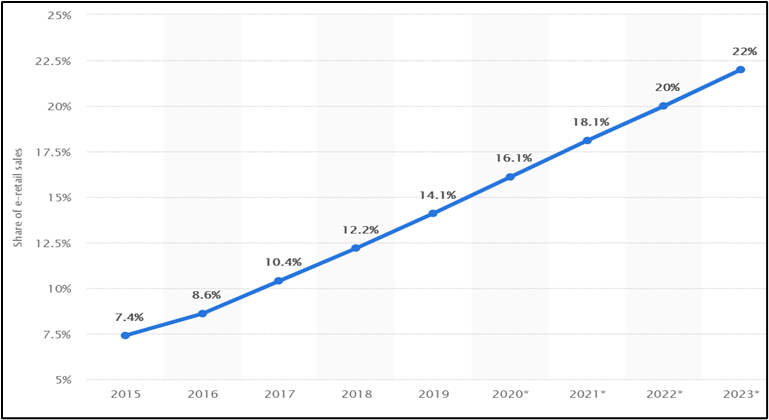
The true figure has certainly leapt in some countries due to lockdowns, in some companies who had been resisting online investments, and indeed in those companies who were most advanced in omnichannel retailing who saw a real possibility of making up for losses from stores through the online route.
As the graph shows, the increase in the share of online retail was a trend before covid. It has likely been accelerated over the past year, which means that it will not return to its previous level but will continue to grow more steeply.
The negative impact on physical stores is a clear example of businesses suffering more from their own actions than from those of competitors. Indeed, the discussions about overstoring have been going on for some time. Even companies which have been aggressively growing their online business have often simultaneously been multiplying or expanding stores.
Some believe the most important asset of retailers lies in their brand value. The recent case in the UK of Boohoo.com acquiring Debenhams and Arcadia brands without the stores, and Asos buying Topshop, again while closing all their outlets, are cases in point. Barneys, once a famous luxury department store operation in the US, is now owned by Authentic Brands Group and licensed to Saks. The selling off of the physical real estate, often initially with a lease-back deal, may be an early sign of the end of the traditional model. The latest case is that of Stockmann in Finland which has recently sold off its Helsinki, Tallinn and Riga stores.
How does one determine whether a particular market has an excess of retail space?
According to Statista, the retail space per person in selected countries in 2018 was as follows:
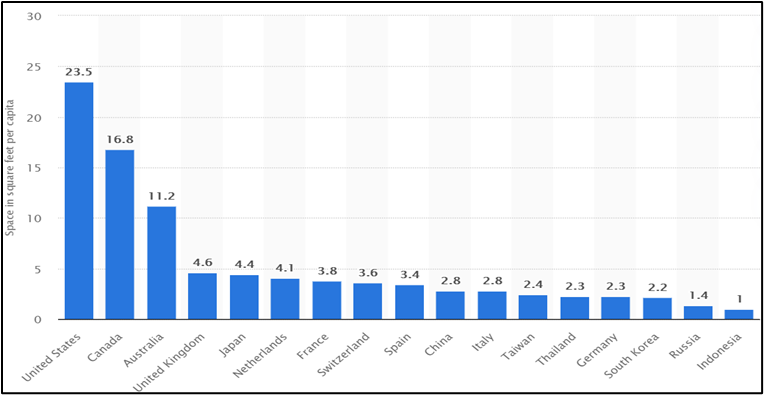
Another trend which arguably started well before covid was the “unmalling” of America and traditional store closures in many other markets too. But according to Coresight, in the year so far in the US there have been 2548 store closures and 3199 openings. The positive balance of openings, however, are often on a very different basis. For a start they have different, shorter and more flexible lease conditions, the rents are lower and/or adapted, and the stores themselves are often quite different (not least, smaller footprints). One commentator has only half-jokingly described stores for the new generation of retailers as a customer acquisition cost. The chart above shows different retail space densities across countries, showing both excesses and potentials.
What’s the use of selling space?
So how have department stores been reacting to this situation?
a) Reducing or closing
As some department store companies have been failing, there has been something of a natural attrition of stores. This has been the case with Debenhams and BHS in the UK, for example. Some companies have been closing stores, starting with the least profitable ones such as Galeries Lafayette transferring part of its regional network to franchise operators, Macy’s or John Lewis. The John Lewis case is particularly interesting since it has long been expanding physical stores: between 2008 and 2016 (the last year it gave figures), it increased selling space by 40% at the same time that it was pushing online growth. It argued for the “halo effect” at the time, saying that £6 out of every £10 spent online was driven by the shops. That figure today is only £3. In the meantime, it is planning to reduce drastically its retail footprint in its Oxford Street store, converting the rest to offices. Something similar is being planned by Marks& Spencer at the Marble Arch end of Oxford Street which has applied to demolish the building and replace it with a smaller store topped with offices. Fenwick, an important store and real estate owner in New Bond Street is doing the same while simultaneously struggling to build an online presence.
b) Changing or transforming
The fact that John Lewis is closing 16 out of 50 stores will free up investment funds allowing it to give the remaining stores a fighting chance. But the remaining stores will have to be different. Not only is John Lewis thinking of a totally different use of space such as housing or entertainment, but it is also apparently looking at other forms of retail such as garden centres. Other companies which own or have use of their store buildings are converting them to offices like Filene’s in Boston, into “dark stores” like El Corte Ingles in Eibar, or thinking of the department store as a mixed-use complex including hotel, shopping and restaurants like the yet to be opened Samaritaine of the LVMH group in Paris. What is clear is that the traditional department store format will not cut it at the moment, if only because it is not sufficiently profitable as a model to survive in current numbers. Other models have come into existence such as Showfields or Neighborhood Goods which would appear to be better adapted to consumers’ expectations. Or going further still, Amazon and Walmart, from opposite directions, seem to be thinking of physical stores as “satellites” in the retail ecosystem.
c) Flagships plus local
While a number of smaller outlets are being reinvented as local stores with an emphasis on personalised service with agile and flexible structures adapted to the convenience of local customers (see IADS Exclusive on local), flagships are developing their USPs for the future and acting as brand carriers for their companies. Recently remodelled or even recently built stores will still have a significant role to play in the future as they stand as attractions in their city centres. Numerous examples prove this point such as Rinascente in Milan, El Corte Ingles in Madrid, Selfridges or Harrods in London and others. Most striking are those which have committed to major architectural creativity, starting with the 2003 Selfridges in Birmingham by System Design with Amanda Levete, and continuing in no specific order with the Galeries Lafayette Champs Elysées with BIG, their Foster designed Luxembourg store, the KaDeWe concept by India Mahdavi, the Breuninger Dusseldorf by Daniel Liebeskind, the Galleria Guanggyo, Korea, by OMA, the above mentioned Samaritaine by Sanaa of Japan, and many others. Architecture is not enough, however, and it will remain to be seen how successful these investments turn out to be in building the brand and attracting customers.
Department stores are dead, long live department stores
Department stores can be city landmarks where life and experiences are lived; they can also be convenient local places for shopping and picking up orders; and they have become the physical face of an omnichannel ecosystem which can take many forms. The nature of the stores themselves is shifting, as is the organisation structure behind them, and the profit model on which they are based. These shifts question the need for traditional store formats and organisation.
Many companies have reached a point where they appear to have too many physical stores and/or too much selling space. The examples above point to actions that have been taken by some companies faced with these problems. In some cases, they are surprising and reflect difficult choices. But they are also signs that department stores are resilient, adaptable and evolving. The need for innovation is greater than ever – and this means retail innovation. We need to remember that technology itself is only a tool (albeit a useful one) and not a substitute for new retail thinking.
Credits: IADS (Dr Christopher Knee)
IADS Exclusive - Retail Review #3: luxury concept stores
IADS Exclusive - Retail Review #3: luxury concept stores
Keeping markets under close watch, IADS collected innovative concepts related to key topics such as luxury experience, contemporary models, and reinvention.
Check out what luxury stores are thinking up to capture customers' attention in the third edition of the Retail Review.
Louis Vuitton, Tokyo
Inspired by reflections of water expressed through the building’s rippling exterior, the luxury retailer’s Tokyo flagship location has been completely transformed by Jun Aoki and Peter Marino. The store offers a full range of collections with upper levels dedicated to VIP clients.
Hermès, Tokyo
As Hermès reopened one of its Paris locations, it also opened a new flagship store in Tokyo inside one of Omotesando’s most notable buildings. Upon entering, customers can peruse silk, jewellery, beauty, perfume, leather, and equestrian collections for both men and women.
Hermès, Paris
Hermès’ beautiful flagship on Rue de Sèvres in Paris has undergone a year-long renovation with its central striking feature of three huts made from ash wood, which the VIP lounge overlooks. The store has been fully reorganized to house evolving product lines, including its recently launched colour cosmetics collection.
Browns, London
The London store is the newest manifestation of Farfetch’s Store of the Future, blending digital and physical experiences by using an app that connects with interactive mirrors to give recommendations and provide product details.
More on Browns’ new boutique in London
Kith, Paris
In Paris, visitors are presented with a restored Carrara marble staircase that falls under a chandelier-adorned ceiling crafted with resin-cast Nike Air Max 1s. The space presents Sadelle’s restaurant in the courtyard and a basement level used as a rotating gallery space.
Swarovski, Paris
Moving away from the accessibly-priced space, a crystal Willy Wonka factory concept appeals to a wider audience to showcase the brand’s shift into luxury. As customers sit on a sofa surrounded by walls of colourful jewellery, salespeople bring the products on trays for a personalised experience.
Diesel Hub, Shanghai
In an effort to converge living, dining, working, and shopping, Diesel has partnered with RTG Consulting and Muse Group to unveil a new concept for the brand called “Diesel Hub” in Shanghai. The 900 sqm retail space offers a Diesel Brave Bar that proposes food, beer, and specially developed spirits.
IADS Exclusive - Sustainability series #5: GOTS
IADS Exclusive - Sustainability series #5: GOTS
What: A certification with strict environmental and social criteria for operations along the entire textile supply chain.
Why is it important: The recognition of the GOTS certification across consumers and business channels has grown incrementally year over year and has a direct impact on purchasing and partnership decisions.
Textiles have proven to be an important good in the past year as COVID-19 has called upon many industries to shift their supply chains to answer the increasing demand for masks and medical supplies needed around the world. To continue the sustainability series, we will explore one specific certification that addresses organic textile production: the GOTS certification. As consumer interests in the transparency of the supply chain connected to their fashion brands continue to rise, department stores need to promote their GOTS products and partnerships and ensure that there are sufficient organic products available for these environmentally aware consumers.
What it is
The GOTS (Global Organic Textile Standard) is the world’s leading textile processing standard for organic fibers. The standards were developed by the certifying bodies IVN (International Association Natural Textile Industry), JOCA (Japan Organic Cotton Association), Soil Association, and OTA (Organic Trade Association). GOTS enables textile manufacturers to qualify their organic fabrics and garments with one certificate accepted in all major world markets. This is an important step towards the harmonization and transparency of textile labels.
A GOTS certification is an assurance that the product meets the global standards for the processing and manufacturing of organic textiles. The standard covers the entire post-harvest processing including spinning, knitting, weaving, dyeing, and manufacturing of apparel and home textiles made with certified organic cotton and wool and includes both social and environmental criteria. GOTS is a key certification to ensure the authenticity of organic fiber and its safety.
How it works
GOTS sets the standard by creating requirements for the production of organic textiles to make sure every step of the supply chain is covered from harvesting and sewing to packaging. The requirements are based on environmental and social criteria to guarantee that the textile is produced in an eco-friendly manner. It also certifies that laborers and workers are protected and treated with fair trade norms during the process.
Some of the key features of GOTS is that it prohibits the use of harmful chemicals in the production of organic textiles, it covers the entire production process from plant growth to packaging materials, and the textile must have 70% organic fiber at minimum. If chemicals are used, they must adhere to strict environmental and toxicological guidelines. All textiles must meet a certain level of criteria and quality to be certified and the product is tested and appraised at every stage of the process by an experienced certifier. All processors and textile manufacturers are expected to meet strict social criteria to ensure fair trade practices and safe working environments. Yearly audits and surprise checks are conducted to verify that there is a continuance of correct practices.
GOTS is not the only standard that exists in the cotton and textile space. The OCS (Organic Content Standard) is used to verify organically grown raw materials from farms to the final product to increase organic agriculture production. OCS has seen record growth with a 48% increase of certified facilities in 2019. Another noteworthy certification is Oeko-Tex which qualifies that textiles are free of harmful chemicals and safe for human use. While GOTS only covers organic textiles, Oeko-Tex includes certifications associated with organic and non-organic textiles.
Why is it important
Until 2003, the sale of organic cotton items in the United States relied predominantly on e-commerce, mail order catalogues, natural and health food stores, and small specialized eco-textiles shops or boutiques. Today, department stores like Nordstrom and brand stores like American Apparel, Levi’s, Nike, and Timberland also have organic cotton items for sale.
The trend of using organic cotton has expanded a lot from the United States to Europe in the past few years. Typically, brands have found that outsourcing their eco-textile and organic cotton items to Turkey, China, India, and Pakistan can reduce costs and increase economic efficiency. American Apparel, on the other hand, uses GOTS-certified cotton to process sweatshop-free t-shirts made 100% in the United States in downtown Los Angeles. The company’s turnover has increased 50% per year since 2002 and the brand has expanded to Europe through its success.
In Europe, Germany and Switzerland are the top two markets for organic cotton textiles. The French market for fair trade products is also growing rapidly. With the involvement of large brands and retailers, the number of points of sale for organic cotton and GOTS-certified items has exponentially increased and can be found in regular sale channels like department stores and supermarkets.
The concept of organic cotton is successfully being marketed to brands and retailers in the fashion industry as being part of their policies for CSR (corporate social responsibility). The involvement of large fashion brands and retailers that are using organic cotton has generated a lot of attention from other parts of the textile industry, from designers and the media. This has further strengthened the interest of consumers in organic cotton textiles and clothing as well as their willingness to purchase.
Limits and Criticism
In 2019, 40,645 metric tons of organic cotton were sourced from Xinjiang, China, a province with allegations of forced labor, prison labor, child labor, and serious human rights infringements. The region produces one-sixth of the world’s global organic cotton. Credible reports of forced labor involving the Uyghur and the Kazakh ethnic groups in China have caused some countries, such as the United States, to ban the import of both raw cotton and goods containing cotton from the province.
There are eight GOTS-certified facilities in Xinjiang, yet GOTS has failed to comment on the implications or impacts of this revelation of harsh labor environments on the future of these facilities or their certification. GOTS’ silence around the issue is a bit alarming as China has the fifth-largest amount of GOTS-certified facilities in the world.
As the region produces such a large portion of the world’s cotton, the traceability of the cotton from Xinjiang can become easily blurred as it moves through various supply chains and gets mixed with other textiles around the world. Traceability can be a difficult topic, but GOTS was ranked best in the “Traceability of Clothing with Textile Seals” by the German consumer product testing organization Stiftung Warentest. They concluded that GOTS offered full transparency and traceability while complying with strict social and ecological criteria through all stages of production.
GOTS: The latest fashion trend
GOTS-certified textiles have created quite the buzz in the fashion industry from consumer demands. The Organic Industry Survey conducted by Organic Report reveals that savvy customers seek out companies of integrity through the achievement of GOTS certification. It seems to have become the standard that the market expects on a global scale. In 2019 alone, the number of GOTS-certified facilities grew globally by 35% from 5,760 to 7,765 located in 70 different countries. The growth has been seen in both production and consuming regions.
Retailers do not need to be GOTS certified unless they are involved with a business-to-business trade activity where they sell to other retailers or they repack and relabel the GOTS products. The benefits of certification include streamlined processes when adding a product to the certification or getting label approvals throughout the year, a license number that will help keep trade secrets confidential, and access and membership to the GOTS public database which receives over 2,000 hits a week in the United States.
Though retailers and department stores do not need to be GOTS certified, it is important that they are transparent about their affiliation, if claimed. While the GOTS logo can be used on websites or labeling, retailers need to make sure not to give the impression that all products are GOTS certified. If the GOTS logo is used in general to show that GOTS goods are sold among others, each GOTS product must show the logo with its license number, label grade, and certifier reference. The GOTS organization audits and investigates any unauthorized or misleading use of the trademark and will take legal or public action if needed to safeguard the credibility of the program and labeling system.
With COVID-19 increasing the demand for masks and medical gowns to be manufactured, being GOTS certified has helped some United States companies win state and federal contracts because of their proven traceability systems. This raises a few interesting questions to think about. Does this mean that GOTS certification can bring a competitive advantage not only with consumers but also in the business-to-business world? Can affiliation with GOTS certification open doors to other business opportunities? On the consumer side, should department stores ensure that there is a certain percentage of GOTS-certified merchandise offered to meet the rising customer demands?
Credits: IADS (Mary Jane Shea)
Read Also: Textile Exchange Organic Cotton Market Report 2020
Read Also: GOTS label guidelines
IADS Exclusive - Department stores selling books and culture
IADS Exclusive - Department stores selling books and culture
Department stores today rarely offer books, music, films and other “cultural” goods. These have reverted to specialists, chains and online retailers. However, the chains have consolidated and are doing less well; and the digital retailers appear to have peaked, while smaller, local booksellers are gaining in popularity. Is it possible that department stores could once again find a place for these goods in their local offer which has gained in popularity during the covid pandemic?
In the beginning was the word
One of the earliest US department stores, Marshall Field’s in Chicago, was famous for its customer service (“give the lady what she wants”), its revolving credit and for the use of escalators. But in terms of assortment, it was notable among other things for its legendary book department which introduced the idea of “book signing”. Its book department is now long gone (the store trades as Macy’s) as indeed book departments in so many department stores have disappeared.
These book departments were often paired with music (vinyls, cassettes, CDs) and films (VHS, DVDs) which have undergone such a revolution, both technological and commercial, that they quickly became the exclusive domain of specialist retailers which have now more or less completely gone digital.
But what happened to books? Department stores were the victims first of the growth of specialised
r6675_9_booksellers_that_have_closed_for_good_across_the_years_business_insider.pdf
. These included in the US, Bookstop (1982) acquired by Barnes and Noble; Borders Books (1971) taken over by Kmart and eventually liquidated in 2011; Crown Books (1977) liquidated in 2001; Waldenbooks (1962) merged by Kmart with Borders and liquidated in 2011; B Dalton founded by Dayton Hudson department stores (1966) acquired by Barnes and Noble in 1987 and operated until liquidation of the last 50 stores in 2109.
In the UK, a similar growth and consolidation movement was taking place with Dillon’s, Ottakar’s, Books Etc (part of Borders), and the 115-year-old Foyles gradually becoming part of Waterstone’s.
“You’ve got mail”
This growth of book chains was portrayed in the 1998 movie You’ve got Mail about the giant book chain threatening the local bookstore business. According to Experian, the number of UK bookshops fell between 2005 and 2012 from 4000 to 1878.
However, neither of the two book giants Barnes and Noble nor Waterstones is currently finding life easy, not least because of the entry onto the market of Amazon, starting slowly in 1994 to digitise the book business first through online selling of paper books, then through digital book sales.
While the sale of e-books was growing, that of physical books continued to fall, for example from from
r6677_9_rise_of_e-books_results_in_50_of_bookshops_closing_down___the_drum.pdf
. However, others claim that the decline of bookshops has now significantly slowed, and furthermore, that the number of independent bookshops grew by 35%
https://www.iads.org/files/pmedia/public/r6676_9_why_the_number_of_independent_bookstore...pdf
r6676_9_why_the_number_of_independent_bookstore...pdf
. E-book sales have recently been fairly static and subscription services modelled on Netflix or Pandora have struggled while the resilience of paper books have proved a boon to independent booksellers
https://www.iads.org/files/pmedia/public/r6678_9_the_plot_twist__e-book_sales_slip_and_...pdf
r6678_9_the_plot_twist__e-book_sales_slip_and_...pdf
. E-book titles have been declining generally, including for example Italy where they fell by 5.4% in 2019 after falls of 17.2% and 15.9% the two previous years.
The rebirth of independents
Waterstones, which appeared to be in deep trouble ten years ago, is reinventing itself under James Daunt of the ex-independent bookshop on Marylebone High Street in London, Daunt’s bookshop (now part of Waterstones). Elliott Management, Waterstone’s owner, agreed in 2019 to buy US Barnes and Noble in a $ 683 m deal. James Daunt will move to New York and attempt to work his magic on the 627 US stores at the same time as continuing to lead Waterstones. He claims that in the book trade, Amazon has probably reached the peak of its influence and that there are limits to the online experience.
One of his strategies at Waterstones’ 280 shops has been to devolve power to local managers particularly over purchasing. This contributes to a more efficient management of stock, reducing the costs and time involved in handling returns, books bulk ordered by head office with little regard for differences in regional reading habits.
One of the competitors which Barnes and Noble will be facing is, of course, Amazon itself whose 20 or so shops around the country are benefitting from the data that Amazon collects on the market. Publishers on their side are suffering under the brutal negotiating techniques of Amazon which is threatening publishing as it has already music and films. On the other hand, of course Amazon has opened the world of books and enabled publishers to reach a wider market.
The local offer for the local department store
Notable bookshops around the world include Daunt’s in London or Lello in Porto representing an almost caricatural but striking model of traditional bookshop architecture; The Strand in New York with its reported “18 miles of books” and its passion for everything written including banned books; Shakespeare and Co in Paris, the archetypal writers bookshop with its rich history of famous patrons (which is suffering badly during the current pandemic); Livreria Cultura in Sao Paolo serving as a spacious and comfortable meeting place in modern design style; Starfield in Seoul with its truly breath-taking height of bookshelves. All of these demonstrate the importance of branding, each one immediately recognisable in ways that the chains cannot match with their “cookie-cutter” formats, however innovative they may seem at first.
They also all know their customers and have made deliberate choices. A more recent version of this is the local focus of the kiosk formats emerging in Barcelona which cater to local customers and offer targeted press, magazines, coffee, and some seating.
Some department stores have not abandoned books. Indeed, Harrods entrusted its book department to Waterstones for 20 years until 2011 (when it switched to WHSmith). De Bijenkorf in Amsterdam has handed its book department over to AKO, part of Audex, in their words a partner who is able to target the Bijenkorf customer. In a similar vein, Manor in Switzerland has recently signed a partnership with French international Fnac group to provide books, audio, video and electronics. Fnac has the same deal in Andorra with Pyrenées department store. Printemps in Paris has a collaboration with the emblematic Gibert bookstore. The BHV store in Paris offers a book selection which is tailored to its customers, as does the Bon Marche. KaDeWe has a selection of books and art on the fifth floor, Selfridges offers a selection, while Ludwig Beck in Munich still offers books alongside its famous and very substantial music department.
Whether or not these examples are profitable, they may nevertheless constitute efforts at generating traffic, which department stores are sorely in need of currently. They might achieve this through the local appeal of their offer, through the theatrical experience they generate, and through the contribution to the value of the retail brand, just as the book department at Marshall Field did in its early days in Chicago.
So what about department stores
If, as seems to be the case, there is a continuing market for physical books (and perhaps other cultural goods), department stores might consider regenerating their offer to customers in some form or other.
The offer might be centred around convenience (guides, reference books, magazines…) which is what Harrods appears to be opting for with WHSmith rather than Waterstones; or it could consist of inviting a local notable shop to open a branch in the store just as so many have invited fashionable restaurant formats into the store.
This raises the question of whether the culture offer should be own-run, an arguably costly solution, or whether it could be entrusted to a specialist as has been the case in Bijenkorf.
Whatever is decided, a book or cultural goods offer opens the potential of a collateral offer of stationery, writing, cards which can all be personalised, and which potentially may be more profitable.
Some department stores see books and more as part of a “gift” offer such as the Galeries Lafayette “System Bookstore”, the design department at Rinascente, or local museum shops, for example. Some books are published quite explicitly as gifts or coffee-table books, and books in general as gifts are traditionally seen as less personal than jewellery, but they say more about the giver. Amazon has a category explicitly allowing purchasers to send books as gifts.
Finally, books and indeed other cultural goods need not be grouped in a specific department but may be scattered around the store to create a lifestyle feel, just as Selfridges may sell cookery books in one of its restaurants, or fashion books in various departments.
Credits: IADS (Dr Christopher Knee)
IADS Exclusive - Sustainability series #4: Amfori
IADS Exclusive - Sustainability series #4: Amfori
What: A global non-profit business association promoting open and sustainable trade.
Why is it important: The association empowers members with a network of producers and suppliers that are aware of the concerns department stores face and can simplify retail supply chain operations through audit standards.
In today’s world, organizations are held accountable not only by the government but even more so by consumers. It is becoming necessary for businesses, especially the fashion industry, to become transparent about the impacts that their supply chain has on workers and the environment and that they take responsibility for instances that happen in each part of the operation. Many businesses have turned to audits such as Amfori to create a channel of ethical transparency for all stakeholders.
What it is
Amfori was founded in 1977 as the Foreign Trade Association (FTA) to represent the foreign trade interests of European retailers, brands, and importers to European and international institutions.
Over the last 40 years, the company has rebranded and expanded its scope to social and environmental responsibilities to assure that goods sourced worldwide are coming from supply chains that respect workers and the environment. Amfori provides companies with a system to improve their social compliance within their supply chain on a global scale.
Amfori membership has grown in the past decade from 23 members in 2004 to over 2,451 in 2020. It has a combined annual turnover of over $1.5 trillion, making Amfori the largest social compliance initiative.
Vision 2030
In 2017, when Amfori celebrated its 40th anniversary, the association launched Vision 2030 which is a strategy to address the challenges that technological advancements and changes in political thinking could bring for sustainable trade. Vision 2030 is centered around 5 objectives: build the organization to be fit for the future, support the members through insight, expertise, and influence, inspire action around the world, grow high-performing people to become the leaders of a sustainable tomorrow, and prosper by contributing to the SDGs (Sustainable Development Goals) to increase human prosperity for all.
Through the guidance of the United Nations’ SDGs, the association hopes to make a social, environmental, and economic impact. Amfori promotes compliance and improvements within global supply chains leading to important discussions about social issues. The organization supports companies by increasing the supply chain visibility which helps address pressing environmental changes. Amfori’s objectives protect and improve international trade interests which is crucial to sustainable development, inclusive economic growth, and human prosperity.
How it works
The association offers three different products: Amfori BSCI, Amfori BEPI, and Amfori Advocacy. Through these product lines, Amfori hopes to enable businesses to succeed by providing world-class services and tools that allow them to trade openly and sustainably while helping shape the right policy environment for open and sustainable trade to flourish.
The Amfori BSCI (Business Social Compliance Initiative) platform provides a single place for all supply chain performance information which helps members make decisions about suppliers and measure improvements. It aims to improve social performance in the increasingly complex global supply chains. An audit to ensure compliance involves a thorough on-site assessment of supplier facilities by professional social auditors which are executed every two years. Though Amfori BSCI does not provide a formal certificate, the factory profiles and audit results are kept in a database that members can use to make decisions on which suppliers to use.
The Amfori BEPI (Business Environmental Performance Initiative) platform provides data on environmental performance in supplying factories and farms worldwide. BEPI provides a practical framework that can support all product sectors in all countries to reduce their environmental impact, business risks, and costs through improved environmental practices. While no certification is awarded, the BEPI process is designed to give members a fair representation of their international supply chain performance and allow producers to improve their performance. With the help of a professional environmental consultant, the producer is coached on the production areas that need to be improved.
The Amfori Advocacy offering helps members shape a political, legal, and social landscape where they can drive equitable trade and advance human prosperity. The advocacy team works with a range of stakeholders to ensure trade is responsible, sustainable, and benefits everyone involved. Advocacy helps members satisfy customers’ expectations while helping them maintain their competitive edge. The service provides members with a network of local representatives, country-specific information, political, social, and legal insights, and expertise to be able to make informed decisions.
Why is it important
Amfori provides department stores with a database of producers and suppliers that accept and assume principles of ethical commitment. When the supply chain for retail is coming from various countries with differing labor laws and operational regulations, it can be hard to perform the proper due diligence of each region while meeting the demands of the consumer. Through Amfori, department stores can feel at ease by choosing to partner with providers that are connected through the same responsible vision towards the future of retail.
Amfori is attempting to address the chaos and unnecessary duplication of auditing efforts by providing a common code of conduct and a single implementation system. This will enable all companies that source products from various regions to collectively solve complex labor problems in the retail supply chain. As Amfori compliance is recognized by all participants, manufacturers do not need to repeat the inspection thus reducing workload and management overhead.
Amfori has a better understanding of the issues that department stores face and has even backed the Fashion Industry Charter Communique. This initiative is focused on driving the fashion industry to net-zero Greenhouse Gas Emissions by 2050. The Communique calls for cross-sector collaboration within the fashion industry and focuses on the role policy environments play in accelerating climate action both in fashion production and consumption countries. Members recognize that current business models are insufficient and support the adoption of systematic changes to achieve the goals of the Paris Agreement. The members are trying to make the fashion industry a model for other sectors to follow. Any company that is professionally engaged in the fashion sector can sign the letter of commitment to join in on the initiative.
Limits and Criticism
In September 2019, the Clean Clothes Campaign criticized the social audit industry in a report alleging that it prioritizes brands’ reputations and profits and fails to meet its mission of protecting workers’ safety and improving working conditions in global garment supply chains. The organization claims that there were auditing failures in the deadly 2012 Ali Enterprises factory fire in Pakistan and the 2013 Rana Plaza factory collapse in Bangladesh. In both situations, there were Amfori audits done by the testing service provider, TÜV Rheinland, that deemed the facilities safe just weeks or months before the incidents. In the report, German retailer, Adler, confirms that Amfori BSCI members rely on the database to make supplier decisions and that Adler had accepted products from a factory in Rana Plaza because the factory was able to prove BSCI compliance.
Though TÜV Rheinland remains on the approved list of Amfori’s audit vendors, in Amfori’s 2020 Year in Review report, they announced the Audit Assurance Programme as a priority in 2021, which is meant to implement trust and quality back into the audits.
The best choice for European department stores
Amfori’s members come from 45 different countries with 89% of the members having their headquarters in Europe. The majority of the members are importers which represent 66% of the members, with brands and retailers following at 19% and 11% respectively. The two major sectors of members are general merchandising and garment and textiles. Therefore, Amfori can benefit department stores in Europe by sharing best practices and market knowledge around sustainability and social responsibility.
Amfori has also helped members navigate the global pandemic by releasing a report called “Responsible Purchasing Practices in times of COVID-19” to help guide its members through the tough situations that lie ahead.
Though the Amfori audit may not replace other certifications, it reduces the chaos associated with sustainability standards by connecting the garment industry. Through its various members, initiatives, and involvement, Amfori might be the best option for European department stores to focus their efforts concerning sustainability standards.
Credits: IADS (Mary Jane Shea)
IADS Exclusive - Business Case #5: Macy’s & Nordstrom abandon new concepts
IADS Exclusive - Business Case #5: Macy’s & Nordstrom abandon new concepts
Two significant US department store groups, Macy’s and Nordstrom, acquired small innovative formats, respectively Story and Jeffrey, and abandoned them in 2020, perhaps not entirely because of the Covid pandemic. What explains their failure to use these opportunities, and what lessons can be learnt by department stores searching for a new lease of life?
Even before the pandemic,
r6646_9_washington_post_macys_is_closing_125_stores_and_laying...pdf
involving substantial cost savings, the closing of over 125 stores and the cutting of up to 4000 jobs. CEO Jeff Genette said: “We know we will be a smaller company in the foreseeable future”. These measures went hand in hand with a new strategy called “new North Star” meant to turn around the country’s largest department store group. Among those leaving the company since the pandemic is
r6643_9_retail_dive_story_founder_rachel_shechtman_to_leave_macy_s___retail_dive.pdf
, who arrived when
r6641_9_retail_dive_is_macy_s_about_to_reinvent_the_department_store____retail_dive.pdf
in 2018 and created a post just for her called “brand experience officer”. At the time the move seemed to usher in an era of reinvention for the department store group, together with the investment in start-up b8ta.
The same year 2020 saw
r6642_9_retail_dive_nordstrom_closing_its_three_jeffrey_specialty_apparel_stores.pdf
, which Nordstrom had acquired in 2005. Jeffrey’s success, particularly in the Meatpacking District which contributed in no small part to the gentrification of that area of Manhattan, was seen at the time as an effort on the part of the upscale department store to renew itself and help modernise its fashion appeal. After the Nordstrom acquisition, Kalinsky worked in a variety of executive roles at the department store company while still running Jeffrey in New York, Atlanta and Palo Alto. It has now been announced that the stand-alone stores would also close (as well as 16 full-line department stores).
Two examples of well-established department stores acquiring successful and innovative concepts, as well as acquiring the founders’ expertise, in an avowed effort to rejuvenate the department store concept, then abandoning the project (admittedly in a covid year) with little to show for it. Why does it appear to be so difficult for a traditional department store to learn from a radically different but very successful retail format?
Who is Jeffrey?
The Nordstrom connection with Jeffrey is perhaps the least surprising of the two: indeed, department stores, especially higher-end ones, are expected to offer curated assortments, the latest in new fashion brands. This was exactly what Jeffrey Kalinsky had built his reputation on for many years before Nordstrom got interested. In a similar vein, the Maria Luisa space in the Printemps department store in Paris was intended to offer customers the same fashion know-how and selection that the boutique founded in the 1980s became known for. If viewed as a shop-in-shop offering a specific assortment, then Jeffrey and Maria Luisa could conceivably exist simply as another outlet for the concept alongside the boutiques. An example of such a strategy would be that of 10 Corso Como which was looking for expansion possibilities and trialled openings in department stores such as SKP or Lotte and is able to retain independence and flexibility.
However, this was clearly not the case with Jeffrey at Nordstrom since he joined the company and served in several roles, ostensibly to train or influence existing buyers to up the game of the company as a whole in terms of brands and assortment at the very least. He maintained his credibility not by opening a concept in the store but by continuing to operate the Jeffrey stores separately.
r6642_9_retail_dive_nordstrom_closing_its_three_jeffrey_specialty_apparel_stores.pdf
. For several years, this category has been underperforming in department stores. It was perhaps to strengthen this category that the store took on the Jeffrey fashion icon. It should be remembered also that Nordstrom had been planning to open in New York for some time, where Jeffrey had made such a splash among the fashionistas. The Jeffrey image could do no harm to the Nordstrom brand. It was the apparel offer in the full-line stores which needed attention, since the Nordstrom Rack outlets have been performing better.
A good Story
The Story connection with Macy’s is more recent since it was acquired in 2018. Story was a single store operation which attracted much media attention since its launch in 2011. The founder was frequently invited to explain the concept, a constantly changing store and offer according to the “story” of the moment like a gallery whose aim is just as much to sell experience as it is to sell products. The narrative-driven retail concept shop is intended to bring to life an editorial approach around themes such as colour, for example.
Here again, the image advantage derived from this acquisition by Macy’s placed the latter firmly in the camp of department stores seeking to “reinvent” themselves. It also invited founder Rachel Shechtman to join Macy’s as “brand experience officer” signalling its commitment to bringing a fresh perspective to the department store and to retail. Macy’s had been in need of a fresh approach for some time since its uniqueness had been diluted and indeed drowned by its size and standardised model. The promise of Story was expertise in experience; collaboration with a number of other brands; working with small businesses and authentic products with special stories; and running a dynamic event schedule. All more like a magazine editorial role than a classic retailer. Once again, this was touted not as a shop-in-shop, but as a starting point for a major overhaul.
Goodbye Jeffrey, it’s the end of the Story
Whether the formats in question were appropriate to carry the future hopes of large department store groups is, of course, debatable. What is clear is that both department stores were probably seduced by the dynamic impact Jeffrey and Story were having on customers, the media and indeed consultants and retail commentators. Small concepts, linked to strong personalities will behave in certain ways: they will be agile and flexible, they will have minimal organisation structure, they will be subject to the whim and creativity of the founders, they will test and make mistakes, and sometimes they will be totally unsuitable for growth.
Acquiring the founder with the concept does not solve the problem. In fact, the chance of a new concept founder fitting into a large classic organisation structure is arguably quite low. Start-up founders hired by department stores have often left, frustrated at the immobility and slowness of the department stores’ structure as well as their incapacity to cut across the internal siloes.
Scaling is also a significant obstacle to success. In both cases (Story operated one store, Jeffrey three) the shift from operating on a small scale, selecting the assortment or the theme, signing collaborations and managing marketing, to making a difference in very large structures, is an almost insurmountable challenge, unless the expected impact is very clearly articulated and organised. The influence of
r6645_9_vogue_another_retail_goodbye__jeffrey_stores_close_permanently___vogue.pdf
was diffuse, and
https://www.iads.org/files/pmedia/public/r6647_9_wwd_rachel_shechtman_out_at_macys__wwd.pdf
r6647_9_wwd_rachel_shechtman_out_at_macys__wwd.pdf
in large classical department stores.
To buy or not to buy…
As was discussed in the IADS Exclusive: Dealing with Disruption, a radical innovation in any business requires commitment and investment, sometimes at the expense of the established business. The onboarding of Jeffrey resulted apparently in no more than a star consultant let loose in the buying department; the ideals of Story were transformed into rather inadequate and sad gift shops. According to Doug Stephens who apparently had advised Macy’s to acquire Story, “Macy's squandered a golden opportunity to reinvent — not just the Macy's experience but the entire revenue model of department stores generally… but instead of taking a whole Macy's store and moving it over to the Story business model ... they chose instead to treat it as a bauble, a fanciful little concept inside the same horribly boring Macy's store”. Strong words indeed. It is certainly the case that
https://www.iads.org/files/pmedia/public/r6636_9_bof_macys_acquires_story.pdf
r6636_9_bof_macys_acquires_story.pdf
with these acquisitions but as one commentator has written, was it perhaps “
r6637_9_forbes_macy_s_acquires_story__game_changer_or_much_ado_about_nothing_.pdf
”.
These two cases raise an important question: how should department stores think about their revival and innovation in general? Acquisitions of small concepts or start-ups may help with the importing of skills and know-how. There is no doubt for example that the acquisition of the UK arm of buy.com helped John Lewis develop its own online business. But this was approached as a tool for the job and within a year, buy.com had been disbanded and totally absorbed into the mainstream business. Almost the same thing happened at Walmart when it acquired jet.com in 2016 for over $3bn and folded it into walmart.com to help it compete with Amazon. Current online Walmart development would appear to confirm the success of that move. On the other hand, with its acquisition of Bonobos, it was clear that Walmart was buying a brand alongside many others (Bonobos founder who joined Walmart has coincidentally left the company in 2020).
Department stores are not bad at innovation as the small Bloomies format or the Nordstrom Local shops testify. Even acquisitions can benefit a department store business as the
r6639_9_forbes_nordstrom_will_bring_trunk_club_to_stor...pdf
now being moved into Nordstrom stores illustrates. But this has not been taken on with the hope of transforming the business model of the company. For the moment, the two stores remain much as they were with
r6649_9_the_motley_fool_where_will_macy_s_be_in_5_years____the_motley_fool.pdf
probably assured after yet more cost savings, while
https://www.iads.org/files/pmedia/public/r6644_9_the_motley_fool_nordstrom_inventory.pdf
r6644_9_the_motley_fool_nordstrom_inventory.pdf
and relying increasingly on its off-price chain.
Perhaps with department stores, business model innovation or new formats need to be developed in-house. Otherwise, an acquisition should serve as a tool for a specific task.
Credits: IADS (Dr Christopher Knee)
IADS Exclusive - Business case #4: Debenhams and Topshop buyouts
IADS Exclusive - Business case #4: Debenhams and Topshop buyouts
Who doesn’t remember a trip to Oxford Street to check on the competition or just feel the consumption frenzy? Well, the Oxford Street and the high street we used to know will not be the same anymore. Debenhams and Topshop collapses are a brutal reminder of department stores and clothing chains struggle, private equity mismanagement, lack of strategy and then Covid-19 dramatically speeding up the process. Even though the brick-and-mortar shutdowns trend is global and rampant, we might find ourselves at a turning point, especially in the United Kingdom, with Boohoo and Asos buying bits of Debenhams and Topshop.
What has happened to the famous British retailers? What are Boohoo and Asos’s buying strategies aiming at? Are Debenhams and Topshop buyouts specific business cases? Is there a new pattern to be observed?
The high street fiasco
Debenhams and Topshop have been sharing history for a long time. They were both part of the Burton Group in the 1980s and 1990s. Their economic issues go back to before Covid-19 hit the world and the UK last year and they are collapsing at the exact same time.
Founded in 1778, Debenhams was once one of the largest retailers in the UK.
r6628_9_1-debenhams_the_rise_and_fall_of_a_british_retail_institution_the_guardian.pdf
when a private equity consortium (CVC, Texas Pacific and Merrill Lynch) acquired the department store for GBP 600 million. Three years later, the company returned to the stock market for GBP 1,2 billion. The consortium also took out more than GBP 1 billion from selling the company’s real estate and leasing it back. At that point, Debenhams was loaded with heavy debt and tied to very expensive leases. It was too late to remodel the strategy and there was not enough money left for investments such as the much-needed digital ones. Even recruiting Sergio Bucher coming from Amazon was no help. Reducing the store portfolio could also have been a smart, if not a lifesaving move: but while online shopping was expanding, Debenhams was still opening stores in 2017. Moving forward, it went from bad to worse until 1 December 2020, when Debenhams went into administration.
What about Topshop? When Debenhams exited the Burton Group, the remaining part of it became Arcadia Group and was acquired by Sir Philip Green’s family. Arcadia Group’s brand portfolio (Topshop, Topman, Miss Selfridge, HIIT, Dorothy Perkins, Evans and Burton) used to be led by Topshop for more than a decade, with years of thriving business, top models and billion dividends. At that time, there were still plenty of seats left at the digital table, but
r6629_9_2-the_rise_and_fall_of_philip_greens_arcadia_retail_empire_financial_times.pdf
to force Topshop into the online-shopping era and failed to position the brand as one of its leaders. The Nordstrom deal was also probably too little to allow Topshop to really break into the US market. In the meantime, Topshop product offer diluted as competition became fierce, with both brick-and-mortar retailers and online players. In 2018, Sir Philip was also caught up in abusive sexual behaviour scandals, adding more mistrust towards him. Finally, on 30 November 2020, the group entered administration, just 24 hours before Debenhams did.
Get a move on
Going deeper into Boohoo and Asos’ moves, what do we know so far? They are both wunderkind British-born e-tailers chasing Millennials and Gen Z consumers for more than 15 years. Boohoo was first to acquire companies with Karen Millen and Coast in August 2019, then with Oasis and Warehouse in June 2020. In January 2021,
r6630_9_3-why_digital_fashion_companies_are_buying_up_tired_brands_bof.pdf
for GBP 55 million (USD 75.4 million): website, private label brands and customer data. As of now, the website still attracts 300 million visitors a year. Boohoo also bought four fashion private labels that are appealing to the older generation (Maine, Mantaray, Principles and Faith). Thanks to Debenhams’ strong position on the cosmetics and perfume market, Boohoo is acquiring the 1.4 million Beauty Club members. The deal does not include the 130 brick-and-mortar stores and the 12 000 jobs involved. Premium locations such as Oxford Street, the ones that were fought for not that long ago, are not considered. A few days later, Boohoo acquired Burton, Dorothy Perkins and Wallis, all “mature brands” and the last remains of Arcadia Group. It’s a GBP 25.2 million (USD 34.7 million) deal and, once more, it does not include the 216 stores and the countless jobs involved. While only 10% of Debenhams’ customers are also buying from Boohoo, this demonstrates a strong will to grow outside of its existing 20-something business and to target new segments of the market such as cosmetics or older male and female clientele. The company said it’s a “significant opportunity to grow Boohoo's market share across a broader demographic”.
Asos, on a larger scale than Boohoo, aims to become the world’s number one destination for young fashion addicts thanks to its huge, varied and inclusive product offer. The company’s latest move will certainly serve that mission and will strengthen its strategy. As an existing wholesale partner to the brands,
r6631_9_4-asos_to_buy_topshop_and_other_arcadia_brands_for_265m_financial_times.pdf
and sister brands Topman, Miss Selfridge and HIIT for GBP 295 million (USD 411 million). In 2020, Asos increased its sales by 19%, growing from GBP 2.7 billion to GBP 3.17 billion and could count on 22.2 million active customers. Asos said in a statement: “The Board believes this would represent a compelling opportunity to acquire strong brands that resonate well with its customer base.” An Exane BNP Paribas survey states that 40% of Topshop’s shoppers are also buying from Asos. Like Boohoo, Asos does not include Topshop’s 168 stores and 13 000 retail jobs in the deal.
While Boohoo is moving into markets outside of its current core business, Asos is strengthening its position in order to take the lead in its segment. While these are different strategies, both companies will grow their online footprint in the very near future.
Is it to say that Topshop or Debenhams stores will all permanently disappear? It remains to be seen, but one can guess that these digital brands in the making will find themselves in need of a physical approach to the business at some point (as other e-tailers have done). Whether it’s to have a brand billboard, a service touchpoint, a community hub or offer immersive entertainment to customers, stores should remain a key part of the business. Asos’ CEO Nick Beighton hasn’t ruled out the idea of taking over Topshop’s Oxford Street crown jewel “if it becomes financially attractive and we can find a partner to work with on that, never say never”.
Are we all British?
Unfortunately, Brexit will have a major impact on such decisions. What will be the point of running stores when visitors from abroad might not consider UK as a shopping destination any longer? In fact, there is no more tax refund for foreign tourists from 1 January 2021. In 2019, they spent GBP 3 billion on fashion and luxury goods in the UK. “We are now the only country in Europe offering no VAT rebate, so why would tourists not go to Paris instead?” says Paul Barnes, the CEO of Association of International Retail.
Going further, is there a specific British pattern to be observed? What makes Debenhams and Arcadia bankruptcies and acquisitions specific? While the European economy was declining, it was no secret there were too many department stores and clothing chain options on the British high street. Besides and more importantly, British online consumption was increasing rapidly, thanks to (among others) Asos and Boohoo. According to an Office for National Statistics study, British online monthly consumption went from GBP 854 million in January 2016 to GBP 1.386 billion in January 2020. For the month of November 2020, just when both Debenhams and Arcadia were going into administration, ecommerce hit a record GBP 3.250 billion turnover, accounting for 36% of British total retail sales for the month. In this turmoil, winners are the ecommerce moguls for sure, but what is unprecedented is to witness their breaking and entering the British department stores scene.
While British retail and department stores might suffer more than others in the near future, we assume that the ones that are (and will be) surviving through numerous crises, are the ones adjusting to online demand, streamlining their operations and adapting their store portfolio.
One of the many learnings in Debenhams and Topshop’s disasters is also about differentiation, hence branding. Both -as brands- were once magnets to customers. They were attracting them thanks to the values, difference, uniqueness or zeitgeist they were claiming to carry. Whatever you name it, it has been lost at some point of the journey.
The branding question is more than ever a critical question for department stores. It will infuse all of the challenges ahead whether it’s about enhancing and transforming customer experience, growing digital capabilities or providing products appealing to an ever-evolving shopper.
Credits: IADS (Christine Montard)
IADS Exclusive - Remote working: what can department stores learn from the great RW experiment?
IADS Exclusive - Remote working: what can department stores learn from the great RW experiment?
Companies have been exploring the possibilities of remote working for many years. In fact, remote work has even, in some cases, been implemented then abandoned. Department stores have been forced into remote work by the current pandemic. Or at least some of the department store functions have been. Is this likely to become a permanent feature of our retail businesses? If so, what might it look like in more detail? Remote working has raised major issues for HR departments, as well as for management. If the practice becomes widespread, remote work will also have implications for city life and consumer spending more broadly, and therefore on department store customers.
A breath of clean air blowing through the cities
The silence and clean air of recent lockdowns in major cities have been partly due to a significant number of employees working from home.
With the coming of a (hopefully) viable vaccine, is it likely that remote work will continue? According to McKinsey international surveys of different jobs, some 20% of the workforce could work as effectively from home as from the office, 3 to 5 days a week. This would mean
https://www.iads.org/files/pmedia/public/r6491_9_mckinsey_gi-whats-next-for-remote-work-v3.pdf
r6491_9_mckinsey_gi-whats-next-for-remote-work-v3.pdf
. Research from S&P Global Market Intelligence claims that 80% of organisations have implemented or expanded work from home policies and 67% expected these measures to stay in place permanently or for the long term (Candezent, Covid-19 and the retail industry, December 2020).
The effect on urban economics, transport, and consumer spending would be significant. Before Covid, around 5-7% of the workforce worked from home. A shift to 20% would, for example, lower the number of commuters with consequences for transport, petrol/gas sales, auto sales, restaurants and retail. Figures for office vacancy in the US would shift from 16.8% currently to 19.4% in 2021 and 20.2% in 2022. As an example, the sports retailer REI has already decided to sell its new headquarters in Washington before even moving in. It has decided instead
r6571_9_washington_post_rei_plans_sale_of_brand-new_campus_as_i...pdf
across Seattle. (Washington Post) Some argue that
r6484_9_the_atlantic_the_workforce_is_about_to_change_dramatically.pdf
on politics also.
The battle for the office
There are two extreme views of office work:
a) It is a place of pressure, constant interruptions, sometimes harassment, and often low productivity; against which home working is seen as autonomous, happy and in many cases more productive.
b) The office is a place of human contact, creativity, cooperation, empathy and an equaliser. Home working in contrast is an unwelcome and unmanageable merger of public and private, to the detriment of both, added to which it has none of the facilities which make office work efficient.
Some companies have tried and rejected distance working. For example, Yahoo abandoned it in 2013, citing the damage to company culture. IBM abandoned it the same year. Facebook has recently signed a new lease on a big office in Manhattan; and Bloomberg is reportedly offering an extra £ 55 a day to get its workers back to its building in London.
On the other hand, like REI mentioned above, Pinterest has paid out $ 90 m to end a new lease obligation on office space in San Francisco to create "a more distributed workforce". (see The Economist articles:
r6494_9_the_economist_the_future_of_the_office_-_covid-19_has...pdf
and
r6495_9_the_economist_the_future_of_work_-_is_the_office_finished____leaders.pdf
).
The classic office is pretty much a relic of the 19th Century, designed for control and surveillance, and dominated by the clock and the time employees sell to their companies. Changes in the office have broadly been limited to a choice between separate offices or open space. And the choice has been largely dictated by economic and cost factors rather than by efficiency or effectiveness criteria. (The same can be said of "hot desking".) Whatever happens, it is clear that the "office" as it exists today is in need of serious reform; and this means more than just ping pong tables, bean bags and unlimited fruit juice. Arguably, even ApplePark and Googleplex, which are used to lure talent to their office worlds, are merely more sophisticated versions of the same thing (see for example, the novel The Circle by Dave Eggers, and the movie). The Vitra CEO illustrated this view at a conference attended by IADS last September, by opposing cost & control-focused companies (where the work environment is not that important) to creativity-focused companies (where she sees an opportunity for her design company to improve the workspace).
The great divide at work
r6485_9_mit_four_principles_to_ensure_hybrid_work_is_productive_work.pdf
(mixing both remote work and physical presence)**. It is the case not only that some industries are more suited to remote work than others, or that some companies have decided one way or another for strategic reasons, but that different functions may be able to adopt distant practices more easily than others within the same industry or company.
Amid a great deal of uncertainty and differences of opinion, it remains that within retail, and department stores in particular, there is clearly a face-to-face function involved in selling which has to remain mostly physical (even though an increasing number of sales jobs are being advertised as remote – see <https://www.flexjobs.com/jobs/telecommuting-jobs-at-neiman_marcus>) or Container Store (repeatedly voted one of the "best places to work"). The fact that many surveys consider retail to be one of the least likely industries to shift to remote work is undoubtedly because the figures are skewed by smaller independent retailers. Chains and indeed department stores
r6493_9_facttank_working_from_home_was_mostly_an_option_...pdf
.
Other jobs in retail that require physical presence may include fulfilment, and warehouse tasks. It was suggested by the last IADS Academy, that the finance function in department stores is probably the one that could most easily be carried out at a distance. In fact, according to
https://www.iads.org/files/pmedia/public/r6491_9_mckinsey_gi-whats-next-for-remote-work-v3.pdf
r6491_9_mckinsey_gi-whats-next-for-remote-work-v3.pdf
amenable to distance working, retail would include elements at both extremes such as handling data at the remote end of the continuum, and handling goods at the other end where physical presence is necessary. The
https://www.iads.org/files/pmedia/public/r6570_9_retail_week_retail_and_future_of_work_report_.pdf
r6570_9_retail_week_retail_and_future_of_work_report_.pdf
has been highlighted by the current pandemic. And the future of this group
https://www.iads.org/files/pmedia/public/r6492_9_korn-ferry-whats-next-for-sales-talent.pdf
r6492_9_korn-ferry-whats-next-for-sales-talent.pdf
.
However, such a situation divides a workforce, for example into those who work from home, all the time or perhaps several days a week, and those who make a regular commute to the office or the warehouse or the store. It means, within a retail company, a division between those who commute and those who don’t; those who are under classic physical supervision, those who are monitored digitally and those who have more autonomy. For the present it also means between those who are exposed to the virus and those who are not. At both Walmart and Amazon, warehouse and DC workers
r6490_9_wwd_walmart_amazon_workers_seek_pandemic_hazard_pay.pdf
. This is the kind of challenge faced by HR and management in our companies.
Big challenges for department stores
There are many challenges for companies which shift into the "hybrid-remote" world.
- Hybrid workforce: as illustrated above, some groups of employees will not have the option of working from home. This may create resentments over what may be perceived as a perk for some but not others even if they see their company saving on real estate and office equipment and utilities while remote employees are picking up extra costs for these items themselves. (Several companies including Twitter and Slack are
https://www.iads.org/files/pmedia/public/r6488_9_wired_silicon_valley_rethinks_the_home_office.pdf
r6488_9_wired_silicon_valley_rethinks_the_home_office.pdf
after
r6489_9_the_conversation_remote_work__employers_are_taking_over_our_living_spaces_and_passing_on_costs.pdf
.)
- Shift in work culture: there is no doubt that remote working is a very different experience from daily presence in an office. A company or team culture needs to be built digitally as many companies have experienced when hiring and onboarding virtually during a lockdown. Not only does this require a different type of leadership, but it also requires every employee to build a "digital identity", in the same way that employees construct a physical identity in face-to-face contact in an office.
- Management, communication and autonomy: employees are likely no longer to be paid on the basis of the time they spend in the company but on the tasks they accomplish. It is perfectly legitimate to take a break to get lunch for the kids while working from home as long as the job gets done. Performance evaluation and compensation therefore need to take this on board. Also, the whole set of skills which were appropriate for communication in an office may no longer be so at a distance. Informal communication needs to be created anew. Communication through meetings takes place both synchronously and asynchronously, in particular if meetings are conducted online and with distant geographies.
https://www.iads.org/files/pmedia/public/r6487_9_steven_furnell_home_working_and_cyber_security.pdf
r6487_9_steven_furnell_home_working_and_cyber_security.pdf
r6485_9_mit_four_principles_to_ensure_hybrid_work_is_productive_work.pdf
r6486_9_mckinsey_how_companies_can_make_remote_working_a_success.pdf
.
r6484_9_the_atlantic_the_workforce_is_about_to_change_dramatically.pdf
https://www.iads.org/files/pmedia/public/r6483_9_the_great_dispersion_galloway.pdf
r6483_9_the_great_dispersion_galloway.pdf
?
Conclusion: get ready for a hybrid work future
https://www.iads.org/files/pmedia/public/r6569_9_hbr_work_from_anywhere.pdf
r6569_9_hbr_work_from_anywhere.pdf
In general, it would appear that once employees are engaged with the idea,
r6481_9_hybrid_working_calls_for_patience_and_ingenuity___financial_times.pdf
. However, department stores need to be able to cater for both sides and be prepared to go hybrid. Just as we have had to integrate different channels selling to our customers, we may need to learn how to integrate remote and present workforces to produce a seamless working environment which answers the demands of the future company.
Credits: IADS (Dr Christopher Knee)
IADS Exclusive - Retail Review #2: sustainability & community
IADS Exclusive - Retail Review #2: sustainability & community
Keeping markets under a close watch, IADS has gathered innovative concepts related to key topics such as sustainability, local retail and community, and multichannel experiences.
Discover the selection of our second retail review below:
![2021 Retail Review #2 green pea
Green Pea, Turin
A mixed-use centre gathering under one roof fashion, food, culture and leisure with one common motive: sustainability. The project is carried out by Oscar Farinetti, the business man who created famous food chain Eataly.
![2021 Retail Review #2 nike unite
Nike Unite
The latest concept from the sports retailer, focusing on the physical and digital shopping experience for local customers. Throughout the space, the store highlights its staff, local partnerships and the story of the community by including local landmarks and hometown athletes; it is designed in such a way that the local residents feel represented.
![2021 Retail Review #2 orefici 11
OREFICI 11, Milan
U.S. retail group VF Corp has opened a multi-brand space in Milan featuring three brands from the group’ portfolio: Timberland, Napapijri, and The North Face. The space successfully mixes physical and digital experiences, showcasing new ways to do retail in the covid world.
![2021 Retail Review #2 moncler
Moncler, Paris
The luxury winterwear brand opened it biggest store worldwide on the avenue des Champs-Elysées in Paris. The store has been imagined like a Parisian flat, with a corridor leading to several rooms, and was designed using noble material such as marble, wooden floor and moulding ceilings.
![2021 Retail Review #2 foot locker
Foot Locker Community Power Store, Vancouver
A concept dubbed Community Power Store debuted in 2019, that expands to Canada. The three-floor retail experience includes an activation space where events can be hosted for the local community with key brand partners.
more on Foot Locker Community Power store
![2021 Retail Review #2 alhambra
Alhambra, Berlin
It is a multi-concept space where local brands and artists showcase their work. The store provides a full-service amplification kit for emerging brands by offering a space, a built-in social media campaign, impressive staging, as well as professional salespersons and event managers. The space will open during spring 2021.
IADS Exclusive - Business Case #3: Subscription retail
IADS Exclusive - Business Case #3: Subscription retail
Space productivity is, by essence, a hot topic for Department Stores, but the year 2020 literally made it incandescent: in a Covid-19 world where customers are afraid of germs and crowds, how do you make sure they come at all to your store, and, more importantly, come back? Also, in a context when rental, resale and other circular initiatives are being increasingly successful among customers jaded with owning “things”, how do you cope with simply selling products? Some industries found a way to break away from the one-off selling model, and by doing so found out that it also allowed them to increase both their margin and customers’ loyalty. Subscription retail is now expanding across several sectors, and might very well be an option for department stores not only to enlarge their services range, but also pocket extra bucks by doing so, while maximizing their existing assets and structures.
What: The subscription retail model across the industry
Why is it important: it could very well be an option for department stores
Introduction – from selling service to renting content, the example of Netflix
Netflix was founded in 1998 with a seemingly simple idea: a mail service of physical copies of movies & shows to be selected from a website. Apart from convenience, its specific angles were:
- Value for money: an unlimited plan with a fixed monthly fee,
- Selection: an advanced recommendation engine focused only on available copies, diverting the demand from only newly released movies, and increasing immediate customer satisfaction.
With the combination of both angles, Netflix became able to orientate subscribers’ choices, therefore freeing itself from the studios’ power. With time, it acquired a good understanding of its subscribers’ tastes, which led to overriding studios and producing its own content. When you know what your customers want, why would you share the margin?
They pivoted from renting a movie (whatever its support) to renting a service (entertainment through stories designed exactly according to the customers’ expectations). On top of this, the low monthly fee, perceived as a bargain by the customer, has great chances to become a permanent part of the household economy precisely due to its low price.
How does this relate to department stores? As of today, they sell a product, with the hope that the store name, experience, or service quality, will lead customers to return, just like when Netflix used to send DVDs. At the same time, department stores have a great customer knowledge (in terms of tastes and behaviour offline and sometimes online), and for most of them, manage a content, be it via a “unique” & “curated” selection, or, more prosaically, via their private labels, in a similar way to Netflix’s own productions.
In the hope to systematise customers’ trips to department stores, is there a way to use existing assets, i.e. customer knowledge & content creation, in a pivotal way such as Netflix? Is “subscription retail” an option to increase sales and productivity? What can we learn from other markets and channels?
Subscription retail as a paying members’ club
A first form of subscription retail embraces the notion of exclusive member’s clubs, accessible with a fee. This enhances the club’s perceived value while financing the exclusive services provided (in theory). For instance, when applying to Prime, Amazon customers buy the ability to know exactly when they will receive their order, shipped for free. With this system, even if it is reported to be unprofitable, Amazon significantly increases its 150m Prime members’ loyalty. As an additional free perk, they also get access to Amazon Video and Music, which helps Amazon to improve its algorithms.
Another example is the REI Co-op membership programme. Not only do members have access to exclusive events, sales, limited-edition members-only products, lowered rental fees and specific activities, but they also receive an annual dividend on REI’s profits. The customer is buying a creed: it is possible to share values and beliefs (REI advocates for topics such as sustainability, etc..), be part of an entrepreneurial adventure (many customers
r6560_9_reis_crunchy_business_model_is_crushing_retail_competitors___news__analysis___bof.pdf
) and receive dividends for loyalty. REI operates 165 stores across the US and distributed to its 19 m members USD 211 m dividends in 2020.
This model is ideal to capture customers, feed their loyalty (as another example, Retail Restoration Hardware in the US proposes a club with a USD 100 yearly fee: 95% of its turnover is made through members) and generate additional revenue: in 2020, the Amazon Prime program is estimated to have generated a revenue of USD 6,57 6.57 bn.
Is it possible to adapt this model to department stores?
- Membership programmes with qualifying amount spent already exist – it would be difficult to pivot to an upfront payment model,
r6561_9_tokyo_club_a_new_way_to_shop_-_the_new_york_times.pdf
) and this would come on top of digital investments or stores refurbishment, a non-credible option in 2021.
- Execution must be perfect, which is why Target dropped its "subscribe and save"service after 7 years, due to poor execution and lack of appeal for customers.
H&M has recently launched a new brand, Singular Society, with a membership fee model (EUR 9.95 a month) which gives access to collections sold at cost price. H&M claims to try a new business model, relying on the monthly subscription to make a living and not the product margin. However, from the department store point of view, this option is somehow radical, and will also require a significant investment to build the brand equity necessary to be appealing to customers, not to mention that it is currently not applicable to the existing businesses.
If the paying fee is seemingly not an option, what else can be learnt from other industries?
From Saas to subscription boxes
Tech companies were the first to deploy subscription models: rather than selling a software, prone to copies and hacks, why not diffuse it on a free basis, allow trials, and then propose only a subscription? This is what Adobe successfully did in the past years, transitioning from a software catalogue sold on a one-shot basis to a monthly fee granting access to selected plans, to the point of generating 86% of their revenue in 2018. Microsoft, as documented in the IADS article on disruption, achieved more than half of their turnover following the same path.
How can this be applied to physical products?
Subscription boxes are an answer. Varying in costs and frequency, the types of promises are the same across categories: discover with a relative low risk and cost new products (Birchbox), ease customer’s life by automatically reordering, especially in Fashion (Stitchfix), or save money (The Dollar Shaving Club). McKinsey values the US Box market alone at USD 12 to 15 bn.
Surprise customers with an exciting offer: the box business is a savoir-faire mastered by retailers. This is why larger brands and retailers also launched boxes: Urban Outfitter with Nuuly, Macy’s and Bloomingdale’s with beauty boxes (based on a discovery and low price claim) or Nike with the Nike Adventure Club (targeting kids).
However, it requires building from scratch a new activity (from product sourcing to community building and animation, through logistics and invoicing) which is difficult for department stores at a moment when they look to increase the productivity of their existing assets.
Another option could be to add a layer of recurring revenue to an already existing activity: the ‘rundle’.
Ready to rundle?
The term was coined after ”recurring revenue” and ”bundle”, by Stern School of Business professor Scott Galloway. Three types of bundles have proven valuable on the long run:
- A bundle of different products increases its value through the perceived discount,
- A pack including a less popular product is a way to get rid of worst sellers,
- A pack including a new product is a way to have customers try while mitigating risks.
Coupling this approach with a recurring revenue model is efficient, thanks to the perceived low monthly fee (liberating customers from the urge to use the rundle at its maximum: only 18% of gym club members hit the club consistently, translating into a significant revenue / cost of acquisition ratio improvement on the long run for the gym company).
The Amazon Prime Video and Music addition is a perfect example of rundle based on introducing a new product coupled to best seller (free delivery). Apple TV new move to bundle Apple Music, Icloud, Care, Pay… is, on the contrary, a good example of rundling in a single offer a seemingly good value-for-money proposition, looking more interesting than cumulating the various services without the package.
Have we seen an equivalent model in retail? For Christmas 2020, Westfield London has opened popups with Christmas trees, decoration and tableware bundles available to rent for the period of Christmas, to be returned within 10 January. Going further, Ikea has announced a recurring revenue model, which is based on renting furniture. However, after a 1.5 year-long teaser, the service is still nowhere to be found on internet, including on the Swedish website. John Lewis, on their side, have announced a similar furniture rental model through a partnership with Fat Llama. Interestingly enough, this partnership is nowhere visible on the John Lewis website, and not even consistently advertised as a John Lewis offer on the Fat Llama website.
Innovating and limiting risks
Subscription is not equal to renting or leasing:
- A renting/leasing solution involves a down payment, usually not refundable. A subscription down payment is smaller and fully refundable,
- A renting/leasing model has a fixed contract, not the subscription model,
- A renting/leasing model involves penalties if the offer is modified, not the subscription model.
This is why subscription model for cars (Carro), rundle hotels offers (such as Citizen M, proposing a credit of 29 nights at EUR 50 to be used in whatever location of the chain), or even shoes subscriptions by On Running shoes are so disruptive: they are literally non committing, cheap and highly addictive.
Perhaps a way for department stores to explore rundles without taking too many risks would be in F&B, enticing customers to come spend time. As an example, the Pret a Manger initiative proposes, for GBP 20 a month, up to 5 coffees a day, in a non-committing, auto-renewable contract. By following a similar initiative from Panera (coffee subscription for USD 8,99), they exceeded their sales target on the first day by a factor of 5. The catch? The customers cost of acquisition is the production cost of an Espresso. If the rate of active customers is the same as the one for gym clubs, then, the department store is creating recurring revenue even when customers are not active. When they are active, the job is to make sure they buy additional products, just like how Monoprix seems to have built its Place Publique in their new store, with a very efficient merchandising approach.
Space productivity is a crucial topic for department stores. Questions about stores’ ROI and KPI are on everybody’s lips, and the topics of many IADS meetings (IADS Space Productivity Meeting). There is space for new ideas that do not require significant capex and investments other than the courage of proposing smart new options to customers.
Credits: IADS (Selvane Mohandas)
Read also
IADS Exclusive - Virtual stores: the future of retail?
IADS Exclusive - Virtual stores: the future of retail?
With the pandemic, the past year brought its share of new initiatives and the year ahead is going to be no different. Retailers in the world, which endured many weeks of closure in 2020 (up to 30% of total opening time) and are still threatened by further lockdowns in 2021, had to reinvent themselves to reach out to customers directly in their homes.
Remote shopping played a significant part in retailers’ survival via new or upgraded digital tools, such as virtual stores. This new channel provides a more inviting shopping experience than a simple ecommerce and safer than physical shopping. For instance, on a webstore the customer scrolls and browses through a series of pages showing one article next to the other. By contrast, a virtual store is an immersive experience supported by interactive elements allowing customers to actually be in the store; which these are sometimes a perfect replica of the physical spaces. Customers navigate the store and see the products on the shelves, almost as if they were in the physical space. It is a mix between a webstore and a virtual reality experience.
Virtual stores can go from augmented reality try-on to a 3D digital space to navigate. They do not require any material other than a mobile phone, a tablet or a computer to be accessible, and a broadband Internet connection.
Why use virtual stores
As shown with ventures such as SKP-S and Showfields, experiential retail was booming before the health crisis, so in order to provide a similar experience with the pandemic-induced constraints, retailers had to find a way to do it differently, safely and remotely.
E-commerce has exploded with the pandemic. As stores were closed, retailers had no other options than to look for the customer in his home directly, through social media and webstores. Virtual stores complete this offer and bring another experience, different than the ones provided by the other channels.
The immersive experience allows customers to walk around the store in an immersive way, able to see and learn about the products, and potentially make a purchase. According to Obsess, a virtual stores designing company, “on average, customers spend almost as much time on one virtual store page as they do on all the pages in the rest of an e-commerce site combined. The more people engage, the more they purchase.”
Virtual stores have the capacity to recreate the being-in-physical-store experience by using features such as music, augmented-reality try-ons and interactions with experts. It is also a way to share more information about a brand, its heritage and its commitments that sometimes cannot be exhibited as much as they would like in a physical environment, due to lack of space for example.
Just like physical stores, virtual stores also have the possibility to adapt to the season and change scenery and features according to the time of the year, making them even more realistic. For instance, during the Holidays, some virtual stores were decorated with Christmas ornaments and played Christmas music.
It is difficult to measure the importance of virtual stores at the moment as the concept is recent, especially for the ones that emerged with the pandemic; and still remains a minor part of retail. It seems that it is a relevant option for retailers in fashion, beauty and home for example, for whom visual elements are important to secure a potential purchase (contrary to a grocery store). It is also another way to stay connected with the customers and the community, in addition to ensuring a social media presence.
There are several reasons a brand would use the virtual stores:
For Ralph Lauren, it was a way to introduce new customers to the brand’s retail experience even after physical stores re-opened. They recreated the Beverly Hills flagship store and added some music, to make the tour even more realistic. It is also linked directly to the webstore.
![Exclu - virtual stores ralph lauren
Via its virtual store, French beauty brand Clarins introduced the look planned for some new shops in 2021. Showcasing this new concept in the virtual store before physical stores is an opportunity to test it. The experience also offers interactive activities such as a skin diagnosis, virtual make-up testing and the possibility to book appointments with beauty experts. Plus, it highlights features such as an eco-bar filled with beauty water and oil, and points out at which physical stores customers can find it.
![Exclu - virtual stores clarins
Charlotte Tilbury’s avatar greets its customers on the eponymous brand’s recently-launched virtual store, in an attempt to bring humanity inside the digital experience. The store offers the possibility to book video consultations and the convenience of being able to save an item in the ”shopping basket” directly from the virtual store, without having to search for it on the e-shop.
![Exclu - virtual stores charlotte tilbury
It is a way to make their world accessible to everybody. During the first wave of lockdowns, Dior was one of the first retailers to introduce a virtual visit of its Champs-Elysées store in April 2020. The brand gave the possibility to customers to discover the store without visiting Paris. The virtual store is a replica of the physical space and is directly connected to the online store to encourage purchase. The biggest downside however is that it is definitely not convenient for a perfume store to be virtual when you cannot actually smell anything.
Recently opened OREFICI 11, the VF Corp. multi-brand concept in Milan, launched both the physical store and the flagship’s virtual tour at the same time. Opening a physical store in the current context is risky, and VF Corp is using the virtual tour of the store as a back-up in case Italy experiences further lockdowns. The tour does not allow for customers to purchase directly from the virtual store, which is not very convenient, but provides information on the store and on the brands’ engagements.
![Exclu - virtual stores orefici 11
One of the biggest strengths of the virtual stores is that they are accessible to anybody (within the limit of the national restrictions that are sometimes imposed). Physical flagships are generally located in capitals or big cities, preventing many customers from visiting them if they are not able to travel. The technology definitely comes as a complement to the webstore, as it acts as a point of entry to e-commerce. But no matter how convenient virtual stores may be, they cannot recreate the touch-and-feel of instore shopping, nor can the virtual assistant replace an actual store associate.
Virtual stores and department stores
So far it appears that virtual stores are a good options for brands, and biggest retailers have not gone for it yet. NYC-based Showfields rapidly set up virtual tours of the store, during which a store associate walks around the store while talking to the customer via a videocall. The experience is a bandage and a way to stay in touch with an audience, but cannot be truly compared to what other brands have done in terms of virtual experiences.
Virtual stores could be a one-time option for retailers, and department stores, to support the business or a time-limited event. That’s what John Lewis did by launching a virtual Christmas shop last fall. Just like for e-commerce websites, virtual store does not necessarily need to cover the full range of a department store. It seems unrealistic and not very user-friendly to virtualise a five or six-storey department store.
Instead, it could focus on one particular category such as home and lifestyle, which has been booming since the beginning of the pandemic; or advertise a special collection, collaboration, or event. It could also focus on a specific market which is what Lancôme did when launching a virtual pop-up exclusively for Singapore. For the ones who are known to be a destination, it could also be an efficient way to transfer to distant customers the look and feel even though they might not be able to travel or to enter the country (Harrods or Liberty could appear natural candidates to this move).
Conclusion
Virtual stores are not completely new, but they multiplied with the pandemic. The first attempts at virtual stores from a few years ago required customers to use particular equipment, such as augmented reality headsets. The new generation of virtual stores are accessible directly on mobile or on computer, making them more user-friendly and visible to more people.
But it has its limits: a video, and even very smart artificial intelligence, won’t measure up to a live interaction with an actual human being. Virtual stores also have a cost, in terms of development and design, and in terms of technology used to support the system. It also needs a team to make it work and requires a good bandwidth to be experienced.
The virtual store will not replace the physical space. However it comes as a short-term, much-needed support to the physical and online store during this pandemic; and the trend might last beyond the health crisis. The covid-19 virus might be defeated at some point, but it will have changed the world and many habits for ever. Who knows when we will be able to travel again, or walk inside a store without a mask and a regulated traffic flow. A customer may wonder why she would need to get on a car or bus to go a store to shop when she can do that conveniently from home. Furthermore, after the crisis a virtual store will continue to attract and serve the people that can’t go to the physical store. These experiences could take their real place in a brand’s business activity at the same level as the online store.
However, partner at consulting firm Bain & Co. Mikey Vu warns that all virtual stores won’t necessary be successful: "Not every virtual store will succeed. As more companies test the concept, they’ll need to better personalise the experience for visitors, make it easier to discover products and make it a fun experience."
Retail consultant Doug Stephens said: "With virtual reality technology, online shopping could look more like physical stores or completely different environments. […] For instance, if a retailer sells outdoor products, it could design an interactive website that looks like an outdoor environment."
Just like for the physical experience, retailers will have to distinguish themselves from the competition to stand out virtually.
Credits: IADS (Louise Ancora)
IADS Exclusive - Sustainability series #6 Ecocert
IADS Exclusive - Sustainability series #6 Ecocert
What: The number one certifying body of France, and a standard that ensures that a range of products are ecologically produced and sourced.
Why is it important: The certification can be internationally recognized across various sections of department stores from apparel to cosmetics.
As more and more sustainability certifications and labels enter the textile and cosmetics industries, the worldwide adoption and recognition of these standards can become easily blurred or even lost. So, why not turn to the label that started it all? Ecocert was the first certification body to develop standards for natural and organic products and has created a globally recognized standard to provide certified environmentally-friendly products.
What it is
The Ecocert organization was established in 1991 and is a control and certification body that is approved by the French Institut National de l'Origine et de la Qualité (National Institute for Origin and Quality), and accredited by the Comité Français d’Accréditation (the French Committee for Accreditation; COFRAC). It is France’s number one certifying body and has been a reference for 30 years for the certification of ecological products. The brand is widely recognized by consumers and has an international presence in major producing countries.
Ecocert is acknowledged for its expertise in matters related to the environment and to sustainable development. The organization is a global leader in certification in organic farming and organic cosmetics and relies on an international network of 30 branches with more than 800 employees operating in over 110 countries. Ecocert is also a recognized player in the certification of environmental management systems and fair trade and sets demanding standards to encourage economic players across all sectors to adopt more responsible practices. Its range of expertise also covers environmental consulting and applies a rigorous environmental policy to all of its activities.
Ecocert supports more than 1,000 companies in their certification process and has dedicated offices worldwide to be able to service their customers regionally in North America, South America, Africa, Europe, and Asia. With 60% of Ecocert’s workforce internationally located, the organization can work closely with regional regulations and standards to be able to offer recognized certifications for the various locations. For example, in order to sell, label, or represent organic products in the United States, your products must be certified by a USDA (United States Department of Agriculture) accredited certification agency, such as Ecocert.
While France’s institutions created the origin of the standard, Ecocert adapts its standards to meet country-specific qualifications and labels. As each country defines its levels of transparency and material associations with labels, Ecocert partners with local associations such as the USDA to communicate and certify. In 2020, Ecocert acquired “Des Enjeux et des Hommes”, a leading CSR (Corporate Social Responsibility) strategy and change management consultancy business in France that will enhance the company's ability to work internationally by helping companies transition to sustainable models within their ecosystem.
There are 197 Ecocert-certified clients in the United States and 1,162 in Europe ranging from recognized supermarkets like Naturalia to internationally known cosmetics brands like L'Oréal. Not all items produced by these organizations are Ecocert certified, but they do share a level of commitment to environmentally friendly and socially conscious practices. As Ecocert regulates the end-to-end product cycle and beyond, the certification can be obtained by all players in the textile, cosmetics, or eco-product sectors from farmers, to producers, and even to brands.
How it works
Ecocert’s Greenlife business, which attributed to 18.9% of the organization’s turnover in 2019, regulates textiles, cosmetics, detergents, and home perfumes to confirm that they comply with the specifications for cultivation, packaging, quality, origin procedures, and traceability. The standard requires the use of ingredients derived from renewable resources that are manufactured by environmentally friendly processes. There must be no GMOs, parabens, phenoxyethanol, nanoparticles, silicon, polyethylene glycol, synthetic perfumes, dyes, or animal-derived ingredients (unless naturally produced like milk or honey). Also, all packaging must be biodegradable or recyclable.
Within the Greenlife business, Ecocert’s Ecological Recycled Textile Standard (ERTS) label promotes production practices and conditions in the clothing and textile industry that respect the environment and people. It outlines the minimum environmental and social requirements necessary to define the ecological status by covering the product’s design stages, raw material production, manufacturing up to completion, distribution, use, and end of life of the finished product.
To be labeled under the ERTS, the finished product should be made partially or entirely of natural fibers, synthetic fibers, regenerated cellulose fibers, mineral fibers, fibers from renewable materials, or recycled natural or man-made fibers. The finished product must be made up of 50% natural materials or materials from renewable or recycled materials to have an Ecocert label of “Made with X% sustainable material” and contain 70% minimum for the “Ecological textile” or “Ecological & recycled textile” label.
Why is it important
Though clothing and textile products tend to make up the majority of department store inventory, there are also dedicated sections, and even full floors, to other items such as cosmetics and home goods. The Ecocert label goes beyond textiles and is also reputable for efforts in cosmetics.
The COSMOS (COSMetic Organic and Natural Standard) was formed by Ecocert and four other organic and natural cosmetics companies from across Europe including France, Germany, Italy, and the U.K. to standardize beauty certification on a global level. This label guarantees that a product is certified by five international organizations and makes use of the principles in the Ecocert standard.
With Ecocert’s network, range of sectors, and international recognition, it could be the best label for department stores offering a variety of goods to ensure a uniform label throughout the establishment that consumers can recognize across the various offerings. Ecocert has affiliations worldwide which gives the label a broader impact and recognition among consumers.
Limits and Criticism
On the other hand, as Ecocert offers such a wide variety of labels and services, it can bring confusion as to what the label actually means. Consumers have struggled with differentiating between natural and organic products within the label. The launch of COSMOS was meant to provide a uniform standard for natural and organic personal care products, however, critics argue that it has just added to the confusion because now it associates products with five separate labels rather than the individualized labels that once distinguished natural, organic, or made with organic products. Critics of the Ecocert label believe that there should be a uniform logo with a simple and effective message that can be understood across various countries and regions.
Such confusion has led Ecocert to release various clarifications between Ecocert and the COSMOS labels. In a document released by Ecocert, the group warns about three misleading provisions encompassing natural ingredient certification, the use of petrochemical substances, and the calculation of natural and organic origin indexes that may lead to fallacious information about the product. Ecocert has understood the complicated nature of having various labels and associations and is working on creating a clearer message so consumers do not feel deceived.
Ecocert: the one-stop-shop
A lot of natural and organic standards have been introduced around the globe in recent years, but they typically are only adopted on a national level. While noteworthy standards exist in countries like Brazil and Australia, most of the world looks to the United States and Europe in regards to which standards are the most trustworthy. Labels in North America appear to be more fixed while Europe is home to many different certifying bodies and organizations with similar causes. This can make it difficult to compare the labels and objectives internationally.
A recent trend coming from this has been the attempts to form regional and international groupings based on the harmonization of various national standards. COSMOS is an example of one of these international harmonization efforts that bring together Ecocert Greenlife, COSMEBIO, BDIH (Association of German Industries and Trading Firms), ICEA (Environmental and Ethical Certification Institute), and Soil Association. Though the collective approach brings some confusion, the outcome has brought the unification of expertise across countries with an overall objective to use materials that are safe for the environment and human health.
Overall, labeling and certification have become increasingly complex, so becoming Ecocert certified can be an enticing way to wrap many different labels under one umbrella. Ecocert as a whole covers a wide range of items beyond clothing which could be found in department stores. It can be seen as one universal label that is globally recognized by consumers shopping in various sections of the department store.
Credits: IADS (Mary Jane Shea)

