
IADS Press Release: IADS Global Department Store Monitor 2024 - 2025
Global department store sales stabilise at +0.63% during the ‘vibecession’: macroeconomic growth meets cautious consumers amid currency chaos.
The 2026 edition of the IADS Global Department Store Monitor reviews 58 department stores worldwide for fiscal year 2024-2025, revealing modest sales stabilisation despite persistent economic uncertainty. After two consecutive years of post-COVID growth followed by a slight contraction in 2023-2024 (-1.6%), global department store sales recovered to average +0.63% year-on-year growth, marking cautious normalisation rather than robust expansion.
The economic paradox: soft landing meets renewed volatility
Fiscal year 2024-2025 opened with unexpected resilience. The global economy performed better than forecasted, achieving what many economists termed a “soft landing”—controlled inflation without recession. However, this stability proved short-lived. Donald Trump’s re-election as U.S. President in November 2024 triggered a shift toward aggressive protectionism. His entry into office in early 2025 ushered in a period of see-sawing tariffs, trade renegotiations, and supply chain disruptions, adding uncertainty to an already strained global logistics network.
For the retail sector, this created a paradox: while macroeconomic indicators showed improvement—reduced inflation, steady GDP growth—consumers remained deeply price-sensitive and value-driven. This disconnect, termed the ‘vibecession’ by economists, forced retailers to rely heavily on promotions and AI-driven operational efficiency to maintain margins. Department stores found themselves navigating not just economic headwinds but a fundamental crisis of consumer confidence decoupled from underlying economic fundamentals.
The IADS Monitor: measuring performance in turbulent times
Launched in 2021, the IADS Global Department Store Monitor was designed to make department stores’ financial results comparable and comprehensible across a complex sector characterised by changes in ownership, privatisation, and mergers. The Monitor isolates the impact of sales growth from exchange rate effects by using both current and fixed (2021) exchange rates. To account for non-uniform accounting standards, the broken-calendar-year system ensures that retailers’ results are compared against the same global events.
This methodology proved essential in fiscal year 2024-2025. Currency fluctuations, often driven by divergent central bank policies and geopolitical risk premiums, created a stark divide between nominal and real growth.
Currency volatility: the invisible hand reshaping retail
Exchange rate movements fundamentally altered department store performance across regions. While many retailers reported sales growth in local currency terms, these gains often evaporated when converted to reporting currencies due to unfavourable exchange rates. Conversely, currency weakness reshaped international tourism flows: countries with weaker currencies attracted high-spending tourists, boosting retail sectors, while those with stronger currencies faced domestic spending leakage to cheaper destinations.
The impact of tariff uncertainty compounded these effects. Retailers across markets accelerated inventory purchases ahead of anticipated tariff implementations, distorting typical seasonal buying patterns and creating short-term sales spikes that obscured longer-term softness in demand. Supply chain reconfigurations such as shifting sourcing from China to Vietnam, Mexico, or Eastern Europe introduced new currency exposure risks that many department stores were unprepared to hedge effectively.
Japan exemplified currency dynamics—and their risks. The weak yen drove Japanese department stores to record sales of 5.75 trillion yen in 2024, surpassing pre-pandemic levels. Major players, including H2O (+8%), J Front Retailing (+10.1%), and Takashimaya (+6.9%), posted strong gains, fuelled by duty-free sales and Chinese tourism. However, this boom proved unsustainable: by mid-2025, the yen’s appreciation and persistent inflation caused tax-free sales to plummet 40% year-on-year. More recently, a diplomatically driven boycott by Chinese tourists in March 2026 exposed the sector’s historic over-reliance on inbound luxury spending. This demand shifted, with South Korean department stores reporting record-high foreign sales as Chinese consumers redirected spending to Seoul.
Regional analysis: three divergent paths emerge through economic turbulence
The IADS sample, composed of 58 department stores with publicly available information, revealed three permeable categories: organic growth in emerging markets and Southern Europe, strong currency effects in East Asia, and cautious consumer sentiment in mature markets.
- Latin America demonstrated resilience, with Falabella (+10.2%), Liverpool (+9.6%), and Cencosud Paris (+5.4%) achieving growth despite currency appreciation. They leveraged high consumer confidence and multichannel adaptations to navigate economic headwinds, benefiting from domestic consumption patterns relatively insulated from U.S.-China trade tensions.
- India emerged as a growth leader, with Lifestyle (+6%) and Shoppers Stop (+5.2%) capitalising on rising discretionary spending among affluent, digitally engaged consumers. The market’s maturation accelerated with Galeries Lafayette‘s November 2025 flagship opening in Mumbai, in partnership with Aditya Birla Group.
- In contrast, China and Hong Kong faced a structural reset driven by the property crisis and weak consumption, challenges intensified by tariff threats that deterred both domestic consumption and international investment. Parkson Retail Group (-13.6%), Wangfujing (-7%), and Maoye (-13.2%) all declined, while Hong Kong’s Wing On (-10.41%) struggled as currency depreciation made shopping in Shenzhen cheaper for both locals and mainland Chinese consumers. The concentration of Chinese department stores in real estate-dependent business models also proved challenging as property valuations collapsed.
- Southern Europe thrived on a tourism super-cycle, as El Corte Inglés (+2.3%), La Rinascente (+4.3%), and Attica (+8.8%) leveraged a weak euro to attract high-spending non-EU visitors (especially Americans). Conversely, Northern Europe and Scandinavia struggled as currency weakness fuelled inflation rather than tourism, leading to stagnating sales and strategic restructuring for players like Stockmann. While the ongoing absence of tax-free shopping has suppressed international spending across the UK, some retailers are still finding stability. John Lewis announced a 2% staff bonus in March 2026, signalling a resilient domestic performance.
- The U.S. market experienced significant volatility shaped directly by policy uncertainty. Major retailers, including Macy’s, Dillard’s, and Kohl’s, faced contraction as consumers delayed big-ticket purchases amid tariff confusion and inflation concerns. The Saks Global bankruptcy in January 2026, following its USD 2.7 billion acquisition of Neiman Marcus Group just months earlier, sent shockwaves through the industry.
Structural shifts: digital transformation and physical retail renaissance
Beyond currency effects, fiscal year 2024-2025 marked key operational transformations. AI usage transitioned from experimental deployment to operational efficiency, with retailers prioritising backend improvements—inventory optimisation, dynamic pricing, supply chain forecasting—over consumer-facing solutions. The obsolescence of traditional SEO in favour of Generative Engine Optimisation (GEO) altered e-commerce traffic models, forcing retailers to adapt digital storefronts for machine readability to ensure products are recommended by AI agents.
The second-hand and recommerce segment outpaced broader retail growth, with Galeries Lafayette opening second-hand watch and jewellery spaces, while Vinted became the top clothing retailer in France. The personal luxury goods market declined 2% in 2024, with aspirational luxury consumption dropping sharply among Gen Z.
Simultaneously, physical retail experienced a renaissance of quality over quantity. While total store counts stabilised, retailers closed underperforming locations to fund experiential flagships, prioritising immersive experiences over footprint expansion.
Outlook: navigating geopolitical and economic turbulence
The next edition will examine fiscal year 2025-2026 results against an even more volatile backdrop. The second year of the Trump administration has entrenched a protectionist agenda characterised by aggressive tariffs restructuring global retail supply chains. Policy whiplash, including abrupt tariff announcements, sudden reversals, and exemptions granted and rescinded, has made long-term forecasting difficult, forcing retailers to sacrifice growth in favour of resilience.
Concurrently, the escalation of conflict in the Middle East has strained global logistics corridors and impacted key macroeconomic indicators. Energy price volatility has created additional inflationary pressure precisely as central banks attempt to normalise monetary policy, threatening the fragile consumer confidence.
Shifting consumer behaviours, shaped by the persistent ‘vibecession’—a disconnect between improving macroeconomic indicators and negative consumer sentiment—show no signs of resolution.
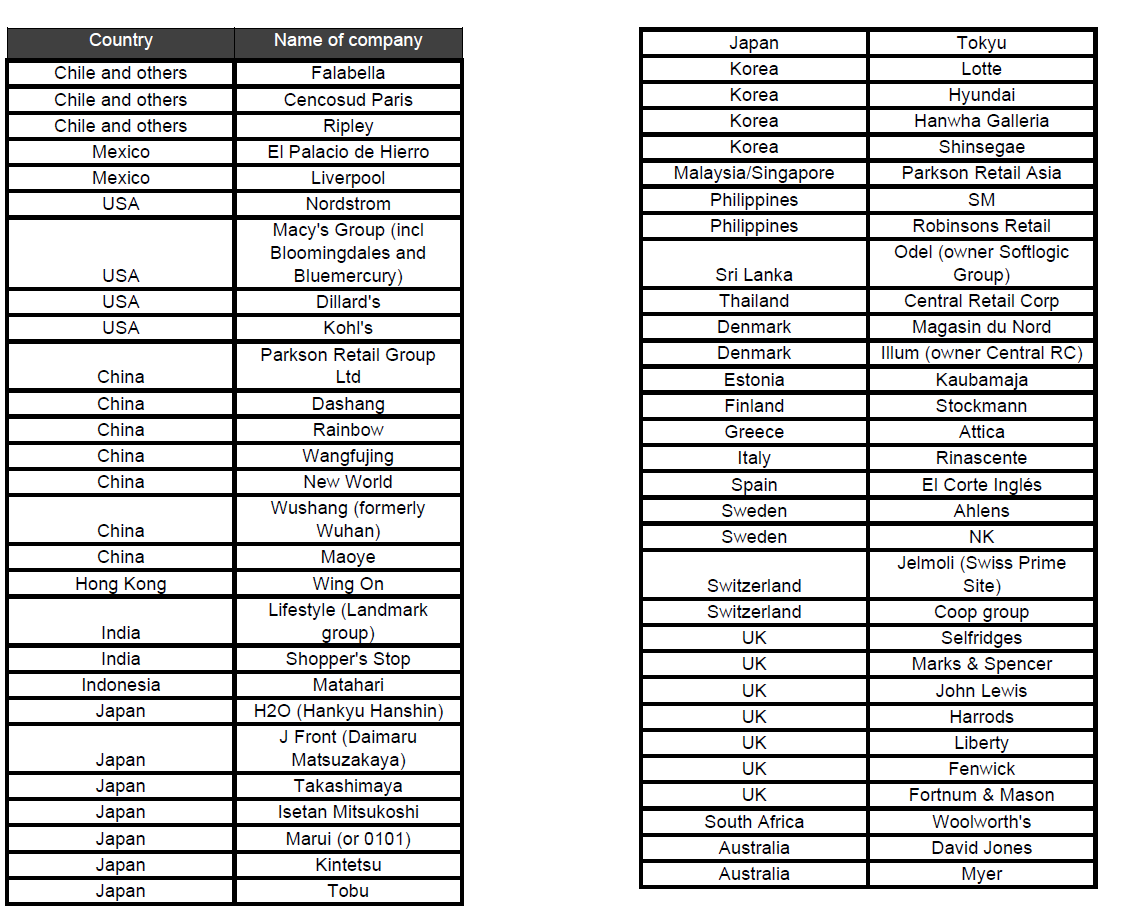
The full list of companies covered in the Global Department Store Monitor is available below. The data sheet can be downloaded by clicking here.
List of companies updated in the IADS Global Department Store Monitor list
Read the full press release below:
IADS PRESS RELEASE: IADS Global Department Store Monitor
Read the full press release, in French, below:
IADS Communiqué de press: IADS Global Department Store Monitor
Access the IADS Global Department Store Monitor datasheet here:
IADS Global Department Store Monitor datasheet
Related posts

Ragtrader follows IADS research on department stores backing fewer, better-presented men's fashion brands
Ragtrader follows IADS research on department stores backing fewer, better-presented men's fashion brands
Heading 1
Heading 2
Heading 3
Heading 4
Heading 5
Heading 6
Lorem ipsum dolor sit amet, consectetur adipiscing elit, sed do eiusmod tempor incididunt ut labore et dolore magna aliqua. Ut enim ad minim veniam, quis nostrud exercitation ullamco laboris nisi ut aliquip ex ea commodo consequat. Duis aute irure dolor in reprehenderit in voluptate velit esse cillum dolore eu fugiat nulla pariatur.
Block quote
Ordered list
- Item 1
- Item 2
- Item 3
Unordered list
- Item A
- Item B
- Item C
Bold text
Emphasis
Superscript
Subscript

Inside Retail sets out IADS’ case for fewer men's fashion brands with more space
Inside Retail sets out IADS’ case for fewer men's fashion brands with more space
Heading 1
Heading 2
Heading 3
Heading 4
Heading 5
Heading 6
Lorem ipsum dolor sit amet, consectetur adipiscing elit, sed do eiusmod tempor incididunt ut labore et dolore magna aliqua. Ut enim ad minim veniam, quis nostrud exercitation ullamco laboris nisi ut aliquip ex ea commodo consequat. Duis aute irure dolor in reprehenderit in voluptate velit esse cillum dolore eu fugiat nulla pariatur.
Block quote
Ordered list
- Item 1
- Item 2
- Item 3
Unordered list
- Item A
- Item B
- Item C
Bold text
Emphasis
Superscript
Subscript